
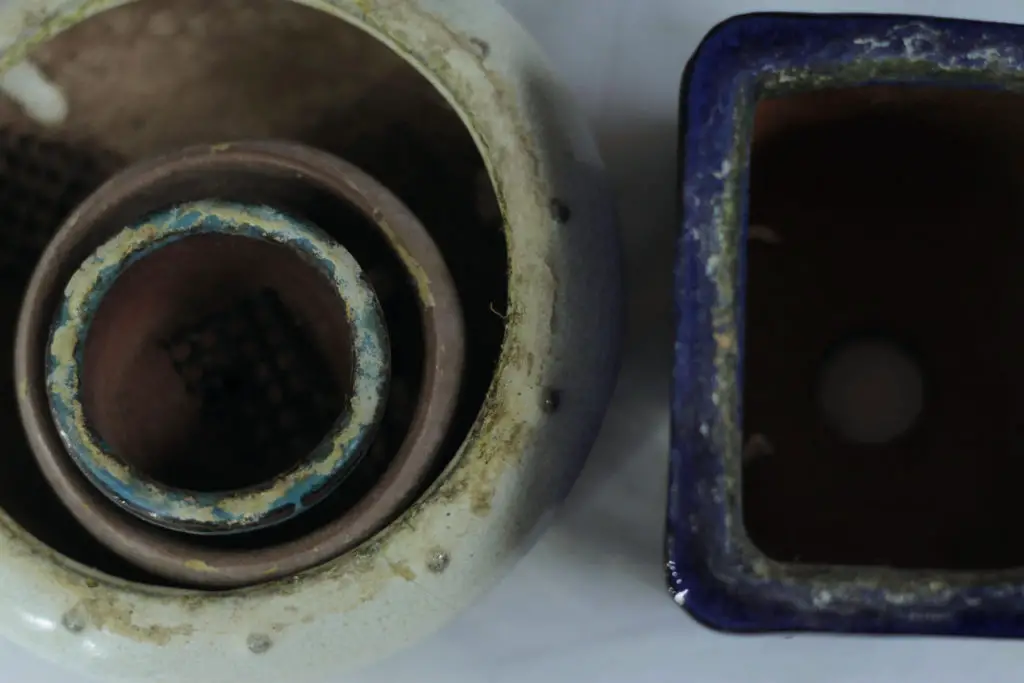
If you have been doing bonsai for a while, you might have noticed a build up of white crusty residue on the lips of your bonsai pots.
This is just a build up of limescale from the tap water you have been using. It is unsightly, but it is totally harmless and can be easily removed.
Page Contents
What Is The White Crust On Bonsai Pots?
The white crust is the left over particles from the tap water you are using on your trees. It is basically calcium carbonate.
Water contains calcium and magnesium in various levels depending on where you live and where the water has come from.
I’m sure I do not need to explain to you that you need to water your bonsai trees regularly. We need to water often as he tree using the water and actively absorbing it through the roots and also partly just due to the fact that some of it will will just evaporate out of the pot.
The individual water particles (the hydrogen and oxygen) are either absorbed into the tree or kind of just float away as they are evaporated from the soil. This means that the calcium and magnesium particles that where dissolved in the water are left behind.
When this process is repeated for months and months, those little particles that are left behind start to build up. This is when you will start to see that crusty white residue start to form.
How do I know If It Will Happen To My Bonsai Pots?
You may have heard water being called “hard” or “soft”. The harder the water, the more calcium and magnesium and other similar minerals there will be in the water.
So the harder your tap water, the higher the chance that you will get this build up on your bonsai pots.
If you live in an area that is built on limestone, you will probably have hard water. As the rain water trickles through the limestone, it absorbs some of the calcium and magnesium along the way.
If you are unsure, you can easily search on the internet to find out how hard the water is in your area.
Is The White Crust On My Bonsai Pots Harmful?
I’ll start with the human perspective. The water from your tap is totally safe to drink. Some people argue it is actually better for you since it has the extra minerals. I have lived in both hard and soft areas and I can safely say that soft water tastes a lot nicer, but apart from that it makes no difference.
As for the effects on bonsai trees? It also shouldn’t cause any trouble.
Trees will actually use some of the minerals, so it can be quite useful for their overall health, but as with all things in life, too much of a good thing can be bad.
The build up of the minerals in the soil can affect the trees ability to absorb water effectively and it can also alter the PH of the soil. However, I’ve never found this to be a problem. I tend to repot fairly often, so I have found replacing the soil solves any problems long before they even start to appear.
This is the same issue that can happen when you repeatedly use too much fertiliser for too long. You can also get a build up that alters the soil. While this can happen, it’s pretty rare. If you are repotting regularly you shouldn’t even worry about this …If you have a tree in a pot for like 5 years or more, you might want to start thinking about what is going on in your soil as maybe by this point the build up may be effecting things.
The only issue with the crust is that it is unsightly. It’s pretty gross looking at this build up all the time, but apart from that its harmless.
What Can You Do To Stop White Crust Forming On Bonsai Pots?
The first and easiest thing you can do is stop using tap water.
Rain water doesn’t contain the minerals that cause the residue, so you just don’t get the build up.
However, I understand not everyone can use rainwater. Maybe you live in a very dry environment, or all your plants are indoors and collecting rainwater is not possible. If that is the case, just use the tap water.
For me, using the tap and getting the crust is just all part of the process.
If you use tap water, you will probably get the crusty build up. You could boil you water first and then let it cool. This will soften your water.
You could also use distilled water (which is basically the same as boiling the water first) or even use reverse osmosis water.
Would I recommend any of this? No. Buying special water or doing all this preparation is just a bit over the top. The water from the tap, even if it is hard, is fine.
The only “preparation” I would do for your tap water is to just make sure you fill your bottle/watering can/whatever you use, after you use it. Then when you come back in 24hrs its already filled and ready to go… but more importantly it’s at room temperature and any chlorine in water will have evaporated.
BUT! Even this is probably over the top. I’ve defiantly forgotten to do this more times than I can remember. I have just soaked my plants with ice cold tap water pretty much straight from the tap and had no ill effects. The amount of chlorine is so low it won’t actually harm your trees and there is even arguments that it doesn’t even evaporate, so even doing this may be a waste of time.
How To Get Rid Of The White Crust On Your Bonsai Pots
I have pretty much said it is unavoidable if you use tap water, so there must be a way to get rid of it? Luckily the white crust is easily removed from your bonsai pots.
I have found that just warm water and gentle scrubbing with an old toothbrush can get the majority of it off. This can be done while the tree is still in the pot.
However, to really get it off and get it back to looking brand new, you need to remove the tree from the pot.
I find the best time to do this is when you are repotting. Which makes sense, when else would the tree be out of the pot?
Anyway, I do nothing to the pot all year. I just let the crust build up and I just ignore its existence. If you want to scrub it every now and again throughout the year, that’s totally cool. I’m just lazy.
When I come to repot a tree, I try and remove it as one big root ball (If you have good root growth this shouldn’t be an issue) I then leave the tree and go and wash the pot.
Leaving the root ball like this will be fine for some time. It is still intact and will not dry out. If you start removing the soil then trim it and leave it fully exposed, its going to start to dry out a whole lot faster! If you have found yourself in this situation, I would place your roots in a bowl of water while you go and clean your pot.
I then put the pot in hot water in the sink and scrub it like crazy with my old toothbrush. I usually add a little squirt of soap too.
I find I get about 99% of the crust off like this. I then dry the pot and inspect my work.
If there is still the odd little bit stuck on, I have found using my fingernail to scratch it off will work. I wouldn’t use anything else in case you scratch or chip your pot.
I’m usually satisfied with this method and after 5 minutes my pot is ready to be used again. As I’ve only used water, maybe a little bit of soap, its easily rinsed and ready to go.
Using Vinegar To Clean Bonsai Pots
If you have a really stubborn crust or you are not going to reuse the pot straight away. You can take it up a level and use vinegar to clean off the white crust.
You just need distilled vinegar. It is really cheap and easy to get hold of from any supermarket.
The process is basically the same. You take your pot and let it sit in vinegar beforehand. The vinegar dissolves the crust and makes scrubbing it off really easy.
You can do it a few different ways. You can make a solution of half vinegar, half water. You can also just use 100% vinegar. I’ve even heard that you can gently heat up the solution before hand to help speed the process up.
The longer you leave the pot in the vinegar, the easier the crust will come off. I’ve actually left a pot in the solution overnight. The crust was pretty much already gone by the time I took it out. I just wiped it with a cloth and it was spotless. No scrubbing needed.
This method isn’t ideal if you are going to use the pot again straight away. Your tree will be fine while you go and soak the pot for 10 or 20 minutes, but I wouldn’t personally use the pot straight away with that same tree. I would want to make sure all the vinegar is gone before using it again.
Bonsai Trees and Vinegar Do Not Mix
You really do not want vinegar getting anywhere near your bonsai tree. That will end badly.
I would not try and put vinegar on your bonsai pot while the tree is still in it!
So, if I use vinegar, I know the pot is not going to be used for a while. I always repot my tree into a different pot.
I like to soak my pot in water afterwards, just to make sure any trace of vinegar is gone. I do this a few times, just to make sure it’s totally removed and I let it sit in the water for a good few hours each time as well.
You have to remember that some clay pots can be quite porous, so I really want to make sure that vinegar has not sneaked into the pot and if it has, I really want to make sure its flushed out. Just remember that the longer you leave it in the vinegar, the longer it will need to be soaked in water to get it all removed.
Can You Use Descaler To Clean Bonsai Pots?
The last option, which I really wouldn’t even consider, is using that descaler stuff.
If you have lived in a hard water area you will know you can get a crazy build up of this calcium/limescale in your kettle.
You pop these descaler tablets into the kettle and it dissolves it all away. As I type this, I am trying to process if this is a good idea or not for bonsai pots. They are used in kettles, so they must be somewhat safe enough if you consumed some? Although, I’m sure you need to flush the kettle out like 10 times afterwards to make sure you don’t die?
Basically I think you should stay away from them. I have no idea what is in them, so I’ve no idea if it would damage your pot and I’ve no idea what they would do if it got into your tree (but I imagine it would be instant death).
I would just stick to the vinegar if you need a good deep clean and avoid the chemical descalers
Bonsai Pot Aftercare
As I said above, I don’t do anything to my pots. I just leave them all year and ignore the build up until it’s time to repot.
If you wanted to give your pots a little clean throughout the year to prevent further build up, that would be totally fine.
You could even give your trees a rinse out every now and again with distilled water to flush the extra minerals out.
If you used distilled water, or rain water every so often, you might be able to help flush out any build up of these extra minerals (Including extra minerals/salts from fertilisers). I personally wouldn’t bother, but the option is there if you want to try it.
If you are not going to repot for many years, I would certainly start considering this. In an instance like this, doing anything to help your pot from getting a build up of minerals is a good idea.
Obviously if your trees live outside, the rain will do this for you and naturally kind of cancel out any build up that you might have been getting from the hose/tap.
Honestly, I wouldn’t really worry about it. If you get a build up, just clean it up when you are repotting and apart from that I wouldn’t think about it too much.
Conclusion
So the white crusts on bonsai pots are sometimes unavoidable, but don’t worry about it, its harmless and just a bit unsightly. Just like the trees, the bonsai pots also can’t look perfect all year round.
(You can read about a more general way to – Clean Your Bonsai Pots)

Hi, I’m Ian. I have been doing bonsai since 2014. I created this site to spread all the knowledge I have acquired over the years. Don’t forget to check out my Youtube videos where I show the progress of my own Bonsai each week or connect with me on social media.
You can read more about me and how I got into Bonsai on the About Page
