
Air Layering for bonsai is a propagation technique that will force a tree to grow roots at a certain point, usually along a branch, while it is still attached to the tree.
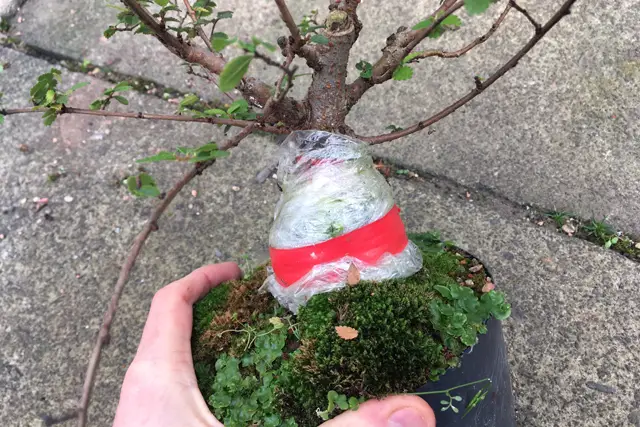
Once roots have formed, you can remove the branch, along with its new roots and you now have a totally independent second tree, for free (You can read about some other ways How to Get A Bonsai For Free)
The benefit of air layering is that you can get a very nice 360 degree root plane very quickly, which is very ideal for bonsai.
Page Contents
How Does Air Layering For Bonsai Work?
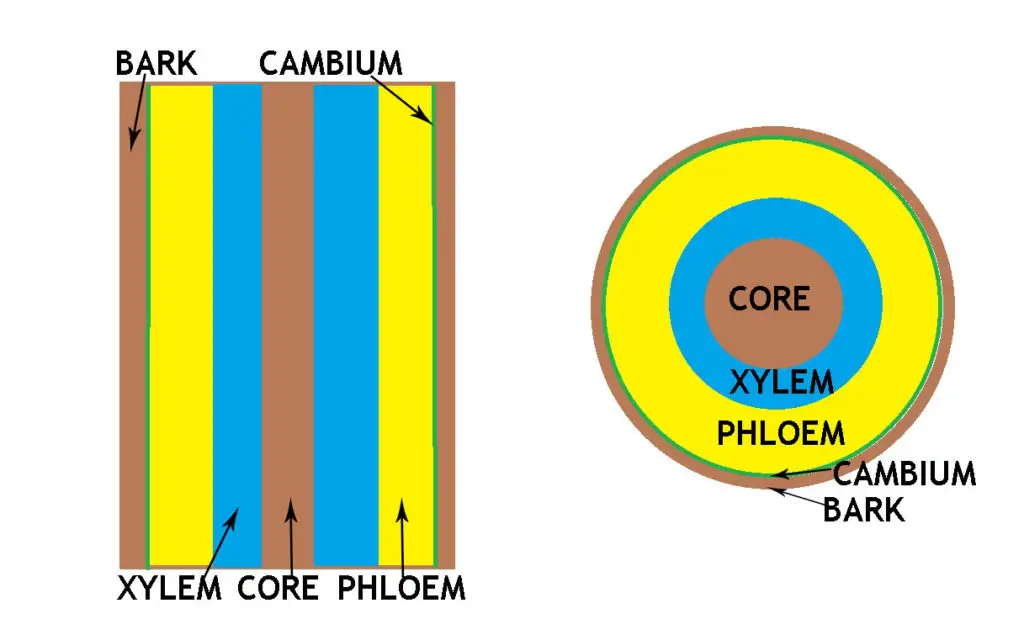
I’ll keep this simple, but if you remember back to school biology, the inside of a tree basically has two pipes.
One pipe pumps water up from the roots to the leaves. This is called the Xylem. The other pipe is called the Phloem, which sends the sugars made by the leaves, back down into the roots.
All trees are built the same way, it doesn’t matter if it is a full size tree or a bonsai. In the center of every tree is a core, which is made of heartwood. This wood is dead, but it is kind of like the structural support that keeps it upright. In branches and younger wood it is is called the Pith, so I will just refer to as the core to make things simple.
The Xylem is located more towards the centre of the trunk and is often called the sapwood.
The Phloem and cambium layers are more towards the outside and are the ones actively growing through out the season.
The bark is then on the outside, protecting everything.
These diagrams are not to scale, but it gives you a general visualisation of what is happening.
Air Layering works by cutting into the branch and removing the bark. This exposes the phloem underneath, which is then also cut into and removed.
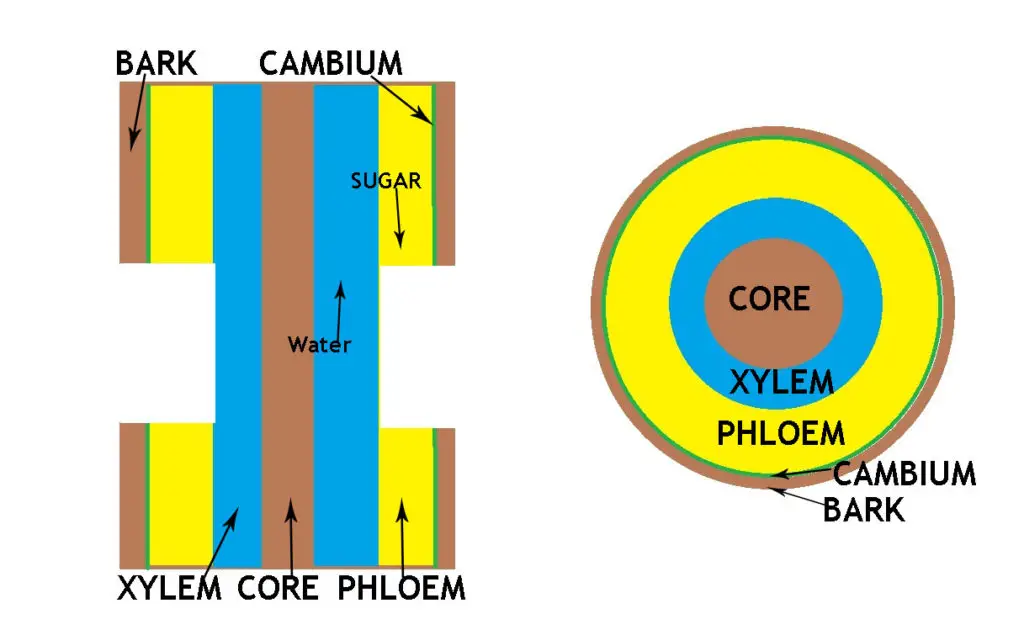
Doing this stops any sugars getting sent down to the roots. But it also means that anything above the cut is still being fed, as water can still move up the xylem.
Because we have removed the downward path for the sugars, they have no where to go and end up building up at the cut site. This build up causes the area to callus over and eventually new roots will form here.
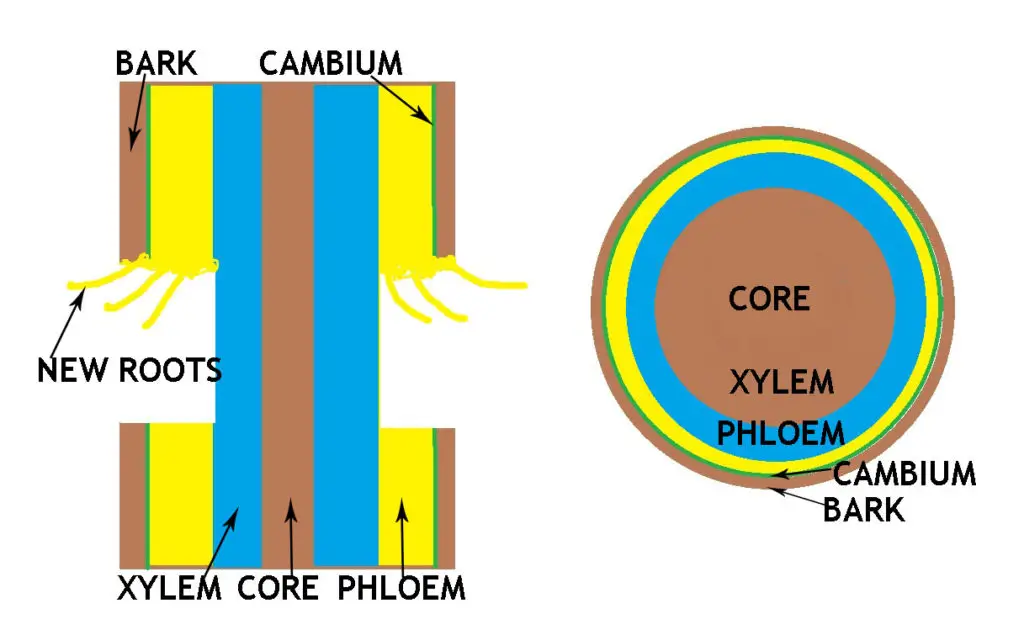
It is a bit more complicated than that, but that’s the basic principle.
So this means you can effectively pick any place on a tree and force it to grow roots there. Then once its ready, you can cut it off and have a separate tree that should now be able to survive on its own.
You will often hear people referring to the removing cambium layer when talking about air layering. This is sort of correct and sort of a common misunderstanding.
The cambium is a thin layer in between the bark and the phloem. So it will be removed and needs to be removed. The mistake is that the terms are interchanged. the phloem is often interchanged with the cambium. It’s not really an issue, so long as you are actually removing the right part of the tree, who cares what its called.
The cambium does play an important role though. It is full of undetermined cells, which the plant uses to grow into whatever it wants. Basically when the sugars starts piling up at the fresh cut with nowhere to go, it’s the cambium solves the problem by taking its undetermined cells and turning them into new roots.
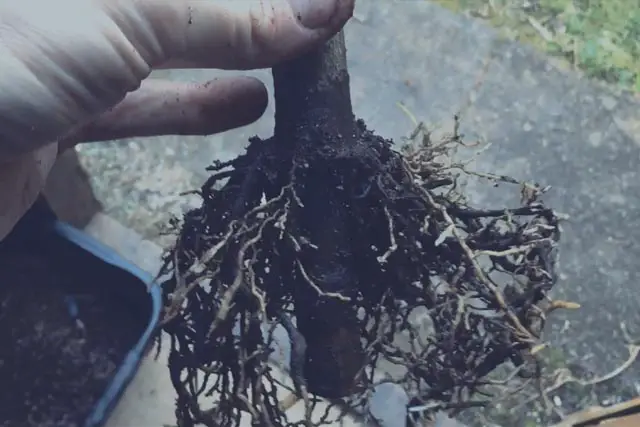
Can You Air Layer Any Tree For Bonsai?
As a basic rule of thumb, nearly all deciduous trees are able to be air layered. Coniferous trees are not as keen. A lot of junipers can with no problems, but pines really struggle. I have heard it is possible, but I have not had any one show me their success, so it may be safe to say they can not be air layered.
Ideally you should look up your individual species to see if it can be air layered before starting.
Some species will work far better than others. If you cannot find any information about how well your species will respond, you should try anyway, as a test and see what happens.
Can You Just Take A Cutting Instead Of An Air Layer?
A cutting and an air layer are very similar. They both work on the same principle that new roots will form at a place you have made a cut. So why bother with the air layer for bonsai?
When you take a cutting you are removing the branch of all its resources and forcing it to make its own. While it regrows it needs water to survive.
A small twig in a damp pot will still be able to take up enough water to survive. When the leaves use water it causes a vacuum like pressure in the stem, which sucks water up. This is how trees normally draw water up from the roots. A small twig in a damp pot can still suck water up like this and get enough to survive long enough to grow new roots and reestablish itself.
When you do this to a larger branch, it will still suck water up from the surrounding soil. However, the rate and amount of water it needs cannot be met from the natural pressure of water movement from the soil. Basically it too big and can’t get enough water so it will die.
Doing an air layer solves this problem as it keeps the water supply from the roots attached while it is developing its new roots.
Younger growth, such a small twig also tend to have more growth hormone in them, meaning it will root a lot faster. Older branches may not have the same levels of this growth hormone, meaning they may take longer to root, which is another reason that keeping them connected to the main water supply is more beneficial.
When To Air Layer For Bonsai?
Air layering timing is similar to repotting. The ideal time can change slightly depending on the exact species and your climate, but in general you want to start an air layer in between spring and early summer at the latest.
The best time is just after he new leaves have opened up until they have started to harden off.
I have personally started a number of air layers just before the buds opened, so basically very late winter and they all worked fine.
However, these where trees that root very easily. To be safe and ensure the best results, I would wait until the new leaves are open before starting your air layer.
(You can read more about – Frequently Asked Questions About – Air Layering For Bonsai)
Are Air Layers Popular in Bonsai?
I think a lot of people know about air layers, but are they actually used? I asked my Youtube subscribers if they had ever tried them, and here are the results:
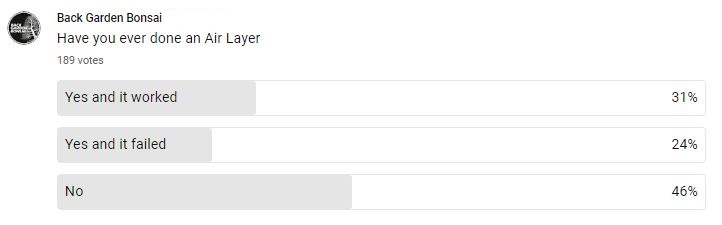
I was quite shocked to find that 46% hadn’t tried to do an air layer. I thought that number would be lower.
I was also surprised to find that those who had tried, the success rate wasn’t too great. It wasn’t quite 50/50, but it wasn’t far off that.
I wouldn’t let that put you off. It is an easy technique …but it is also easy to mess up. If you follow my “how to” that is linked below, you should have a much higher success rate.
Conclusion
Now you know what air layering is and how it works, you should give it try to get your self some more trees.
For information on how to actually Air layer a tree you, you can read my guide – How To Air Layer For Bonsai
You can also see the progress of some of my trees that I have started from air layer:
Yew Bonsai (From Air Layer) Progression
Little Olive Bonsai (From Air Layer) Progression

Hi, I’m Ian. I have been doing bonsai since 2014. I created this site to spread all the knowledge I have acquired over the years. Don’t forget to check out my Youtube videos where I show the progress of my own Bonsai each week or connect with me on social media.
You can read more about me and how I got into Bonsai on the About Page

Pingback: How To Air Layer For Bonsai – Back Garden Bonsai