
You might hear “tanuki” occasionally mentioned in bonsai, but it can be unclear what exactly this means, so I will be going through everything you need to know about them below.
Page Contents
What Is Tanuki In Bonsai?
A Tanuki is a type of bonsai that has been artificially created to make it look much older than it is.
Basically it is when you have a small, young uninteresting tree and combine it with a larger, but more interesting dead tree.
This sounds kind of strange, but when you think of any impressive bonsai, a tanuki makes sense. If you look at a 100 year old juniper, it is going to be a mix of both deadwood and living tree. This contrast is what makes them look so powerful.
The problem is that this can take 100s of years to develop and is really only something time and nature can create. Of course we use some man made techniques to make trees look older, like creating deadwood, but really we are just working with what the tree already has.
A tanuki artificially brings things to the tree that are not natural to it.
The idea of a tanuki is to take a dead tree and plant a living one around it. Usually grooves are added to the dead tree and then smaller whips are planted in to the grooves.
As the live trees grow and develop they swell and fill the groove, merging together so that the dead and alive tree looks like they are one.
This sort of Frankenstein tree starts to look like one tree and makes you think the tree has been growing this way for many years.
If a tanuki is done well you will not realise it is two different trees joined together.
What Is A Tankui In Japanese?
I think it is also important to mention that the Tanuki is actually an animal in Japan, it’s a sort of racoon/badger like creature, but while this animal is real, they also have a more mythical version of this animal.
In folklore it is a bit of a foolish trickster, who can shape shift and disguise itself.
This is of course why the name was also associated with the trees, since they are trying to disguise themselves as a much older bonsai tree.
Why Are Tanuki Bonsai Controversial?
A lot of people see tanuki as dishonest, fakes, or just generally cheating. A lot of the value of bonsai comes from the amount of time that is put into a tree.
You need patience and time to create a good bonsai tree as well as a helping hand from nature to give you the deadwood to work with.
A tanuki skips this line and people just dislike this shortcut as it goes against a lot of the principles of bonsai.
The real issue comes when people try and actually pass a tanuki off as a much older bonsai tree.
Having a tree with lots of deadwood that is actually naturally part of the tree is very valuable, so when someone tries to trick someone into thinking a tanuki is this …and therefore worth more than it really is, it angers people, and I think rightly so.
What Do People Really Think Of Tanuki Bonsai?
My general thoughts on tanuki are that they are generally disliked, but I thought I would double check, so I asked my youtube subscribers and here is what they said:
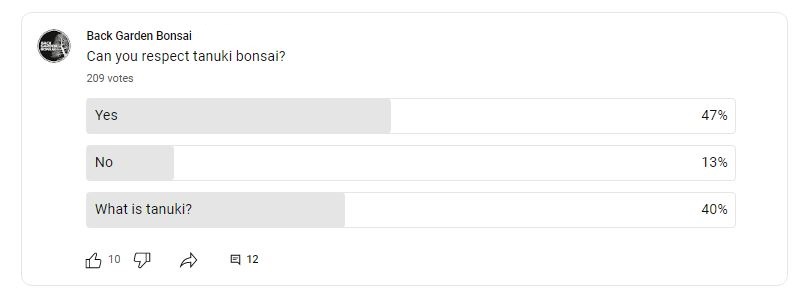
Interestingly, nearly half of people didn’t mind them and could respect them. This was much higher number than I thought.
I was also surprised that 40% of people had not heard of this type of bonsai, but I guess it is quite a niche part of the hobby. Anyway, it was good to see that most people where not against the concept.
Can Tanuki Bonsai Look Good?
How good they look will really depend on the quality of work. Some can look pretty good, especially from far away.
However, if you get up close and actually examine the tree you will start to see how unnatural they are and see they are manmade.
You can see that the dead wood is not actually part of the live wood and that really the whole tree is an illusion.
Are Tankui Bonsai Worth Anything?
Since they are made from cheap young trees and the dead wood is not actually part of the tree, then they are usually not worth a lot, especially compared to the older trees they are trying to emulate.
As I’ve already mentioned, some unscrupulous people will try and pass them off as much more expensive by not mentioning the fact that they are manmade.
I imagine this is more of a problem with internet sales and even then I think the percentage is fairly low, but it is still something you need to watch out for as it can happen.
The usual rules apply, if the price seems too good to be true, it’s probably not true.
What Species Are Used for Tanuki?
The most common species that is used is juniper. Young juniper is often thin and long and easily bent and twisted around the deadwood. Juniper foliage is also easily wired and styled to look exactly how you want it, so you can very easily take a juniper whip and transform it into something cool looking when you make a tanuki.
I am also pretty sure I have seen a pine tanuki. Both pines and juniper work well with deadwood, so they will look very natural if done right.
I am also fairly sure I have never seen a deciduous tanuki,but maybe I’m wrong. However, deadwood and deciduous don’t really work well together, so its unlikely that they are ever made.
Should You Get A Tanuki Bonsai?
This really comes down to personal preference. If you like them, get one. Just don’t get ripped off.
I would probably suggest you don’t buy one, but if you want to make one yourself, go for it.
If you have a dead tree and some juniper whips; why not give it a try. I’m sure it could be a fun project.
I’ve not personally tried it, but I wouldn’t be against it if I had more space to have more trees. Maybe in the future I will give it a go.
Conclusion
Tanuki bonsai are probably not for everyone and that is okay. If you think they are dishonest and cheating, I think that’s totally understandable. On the other hand, if you think they are cool, go for it. Make as many as you want and enjoy them.
What you have in your collection is only your own concern, so do whatever makes you happy and own whatever you like the look of. No one else’s opinion matters but your own.
If you are looking for other ways to grow your collection you can read more about – 6 Ways To Get New Bonsai Trees And Grow Your Collection

Hi, I’m Ian. I have been doing bonsai since 2014. I created this site to spread all the knowledge I have acquired over the years. Don’t forget to check out my Youtube videos where I show the progress of my own Bonsai each week or connect with me on social media.
You can read more about me and how I got into Bonsai on the About Page
