
When you look at a lot of different bonsai trees you will start to see that some look better than others and you might not be able to pin point why this is.
You might also hear people getting very excited about a piece of material that looks a total mess, but they tell you it’s full of potential.
What exactly are they seeing that you are not. What actually makes a tree good for bonsai?
Page Contents
What Makes A Bonsai Good, Can Be Subjective
Firstly it is important to remember that a lot of things in bonsai can be subjective. Just because I say a tree is amazing, doesn’t mean you have to agree.
However, there is a general consensus among bonsai growers about what type of things are desirable in a bonsai, which is what I will be discussing below.
These are more general characteristics of the tree, but even these can be slightly subjective as well. You might prefer trees with one characteristics and I could prefer a tree with the total opposite.
What Actually Makes A Bonsai Good?
Really we want a bonsai tree that is small, but looks like a full size tree. If we can get a bonsai to look like a miniature version of a full size tree then we are probably going to have a great tree.
If we are able to do this is a way that looks very natural, it’s going to be even better.
This is important as we need to remember that the age of the bonsai tree, well more importantly its level of development, is going to play a role in making a tree look better.
In general a tree that has had 50 years of bonsai work done on it is probably going to look better than a tree that has only had 5 years of work.
Its More Than The Species
The species of a bonsai can certainly help it be better than another tree, but its not everything.
Some species are just naturally better suited for bonsai than others, but lets take Trident maples for example, just because a tree is this species does not automatically mean its a good bonsai. It is more to do with the characteristics of that individual tree.
Of course a lot of the characteristics come down to the species, but you will find that some trees just have better characteristics than others, even if they are the same species.
(You can read more about – What Makes A Species A Good Tree For Bonsai?)
What Characteristics Do We Want In A Bonsai To Make it Look Good?
If you actually take a step back from the bonsai tree and start to look at all its different components, you will start to see how different characterises can add quality to a tree.
While these characteristics can even be subjective at times, over all they are desirable features you want from a bonsai tree.
Trunk
The size, shape and thickness of the trunk all play a role in how the bonsai tree will look and it is also one of the hardest parts to develop on a bonsai. If you can get this right, your tree will be set up very well for the rest of its life.
We can argue all day long over whether a trunk should be short and fat or long and elegant, but in general, so long as it has some sort of interest and works with the style you are going for, then it will be a good trunk.
If your bonsai tree is still basically pencil thin, with a straight little trunk, it’s just not going to look as good.
The trunk is one of the first things we notice in a tree and if there isn’t really anything going on here it can really lower the quality of the tree.

Bark
The bark of the bonsai tree is also important. It will depend on what species you are growing, but you will want it to compliment the shape of the trunk. Some trees will have rough textured bark and others will have very smooth bark.
So long as it adds more interest to the tree, then it is going to help it look better overall.
Branches
This is a huge area for subjectivity and really comes down to what style you are going for but regardless of what you are doing, how you structure you branches and how well ramified they are is going to play a role in making your bonsai tree look good.
Branch placement is also a big part of this too. There a number of “rules” around how branches should be placed, but of course these can be broken and the tree will still look good.
Usually the difference between an outstanding tree and an average one is how the branches have been grown.
This is why there are winter exhibitions. Being able to show off those winter silhouettes and all the beauty of the trees structure is what we all want to see and enjoy with our deciduous bonsai.
Leaves
The leaves are of course species specific, but you will want to use a tree that has good leaves.
This means small or at least they have the ability to reduce down in size with the help of good bonsai techniques. Smaller leaves are going to make the tree look more in proportion and more realistic as a miniature tree.
If the internode length on a branch is also very short, this is going to be more beneficial as the leaves are going to be closer together and the foliage is just going to appear denser and it will also allow for more ramification. This can all make a bonsai look more developed and more like a full size tree, which is exactly what we want.
The shape and colour is not too important, but people will grow specific species as they like the leaves that the tree has.
This is also the same for the fall colours. It doesn’t really change if a tree is good or not as a bonsai, but it is certainly a very enjoyable bonus to have.
(You can read more about – How Do You Build Ramification On A Bonsai?)
Roots
The roots are an important part of the bonsai tree and although we do not see most of the root system, what we do see is very important and can really be the difference between a bad tree and an amazing tree.
Trunk Flare
The trunk flare is the first thing you will notice. This is how the tree transitions from the trunk, down into the soil. If the tree just goes straight down into the soil, the tree looks like a stick in a pot.
If there is a wide flare at the base of the tree, it is going to look like it is old and established. It will appear like it has been growing for many years, sending out a wide powerful root system, just alike a tree does in nature.
(You can read more information about Developing A Nebari (Spreading Roots))
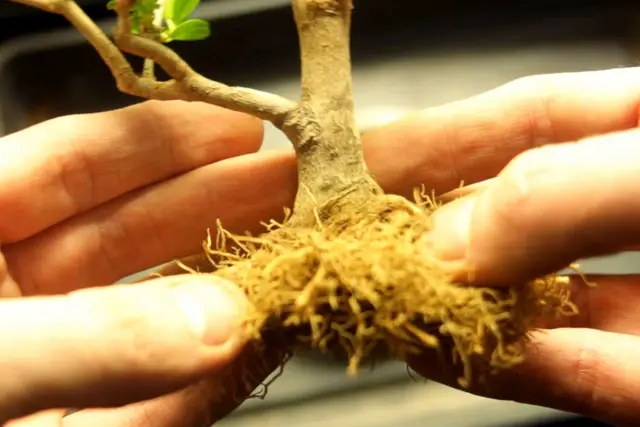
Root Ramification
You also want your roots to have ramification. This is partly so that you can have more fine roots in your pot, which will mean your bonsai tree will be healthy, but it is also for aesthetic reasons.
When a trunk flares out at the base, and then starts to have lots of surface roots that are dividing and ramifying out it just looks very powerful. This is made even better when they are slightly exposed on the surface.
This is how powerful trees grow in the wild and it can really change the look of your tree form something simple to something very beautiful.
Shallow Roots
We also want the root ball of our bonsai to be shallow. This is so we can get it into a bonsai pot. If a tree can’t be grown in a shallow pot, it’s just never going to be as good.
A large part of bonsai is being able to grow the tree in a shallow container as it shows you have managed to build a powerful, but small root system. There is a real magic to seeing a tree look so old and healthy, yet only have a tiny root ball.
What Are People Favourite Characteristics?
I’ve just gone through all the different components that make up a tree, and I thought it would be interesting to see if people put more emphasis on one characteristic than another, so I asked my Youtube Subcribers:
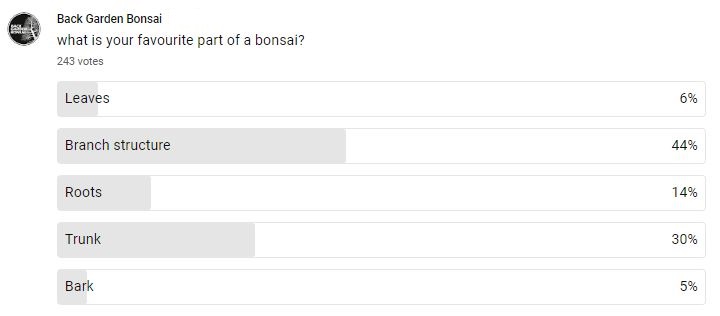
As you can see nearly half (44%) said that they like the branch structure the most. I would argue that all of these are equally as important, but if you wanted to focus on one area to get a good looking bonsai, your branch structure, followed by the trunk are going to be a good place to start.
Pot Selection Can Help Make A Bonsai Look Good
The pot selection can play a role in how your bonsai tree looks. I am usually amazed when I watch videos on youtube and a simple pot change can make an average tree suddenly become amazing.
This is of course very subjective, but luckily it is also very easily changed. Your bonsai tree will probably be in a number of pots throughout its life and sometimes they may not work as well and sometimes you might have an absolute winner.
It is also totally fine to have ugly or just not very traditional shaped pot when you are developing your tree.
You will often hear people say the bonsai pot is the picture frame of the tree. If you think like this, then you need to remember that you do not really need a good picture frame when you are still painting the picture, so don’t really worry about it until your tree is developed and ready for a good pot.
The Health Of The Bonsai Tree Can Help Make It Look Good
This is not really a characteristic, but if your bonsai tree is not healthy, it will not look good …especially if it is dead.
The health of your tree should always be placed over its aesthetics. So long as you keep this the main priority you can slowly chip away at everything else I’ve talked about and develop your tree into something good looking over time.
Conclusion
If you take all the things I’ve have talked about above and implement them into your bonsai trees, you will end up with something that looks great.
A lot of these characteristics will depend on the species you are using, so it is important you pick a good species, then really after this is comes down the material you select and how you develop this over time to make sure your tree as all the best qualities and looks good.
Even if a lot of this is subjective, most people will agree a bonsai tree is good if it has these factors.
(You can read more about – What Are The Benefits Of Having A Bonsai Tree (And Are There Any Negatives?))

Hi, I’m Ian. I have been doing bonsai since 2014. I created this site to spread all the knowledge I have acquired over the years. Don’t forget to check out my Youtube videos where I show the progress of my own Bonsai each week or connect with me on social media.
You can read more about me and how I got into Bonsai on the About Page
