
You may have heard about people using Rhizotonic on their bonsai and you may not be sure what that this is all about.
I am a huge fan of rhizotonic and I think everyone should be using it. I honestly believe it has prevented a few of my trees from dying and just helped speed up their recovery after a repot, so let’s look at what it is and how we can use it with our bonsai.
Page Contents
What Is Rhizotonic?
Rhizotonic is a special potion that I can only describe as magical. It is commonly used across all different areas of gardening and is often called a “root stimulator” but is basically a soil additive.
It is made from marine algae (so basically seaweed/kelp and that kind of stuff) and contains all sorts of nutrients and vitamins that are beneficial for the roots of a plants and the health of the soil.
It does smell kind of funky, but it comes in a cool bottle and it is not a fertiliser, but you do apply it like one. You mix the liquid into your water and water your trees as normal.
Rhizotonic can help promote new root growth and also help a tree in stress recover more quickly …trees often go into stress when we prune their roots, so rhizotonic can help ease that and help it to recover and get back to full health.
How Can We Use Rhizotonic On Bonsai
You can use rhizotonic in a number of different ways with your bonsai, but of course they are all going to be related to the roots.
Yamdori Collection
Probably the most popular use of rhizotonic is for helping yamadori recover after being collected.
When you dig a tree out of the ground, especially from the wild, this can be a pretty big shock to the tree. You will usually find that the roots are not great on these types of trees and it can put a lot of stress on the tree while it tries to acclimatise to its new home.
Rhizotonic is sprayed on the tree and the soil and this can help speed up recover and help new roots form a little faster.
Repotting
You can also use rhizotonic after you have repotted your tree. You tree will be in a weakened state and missing a lot of roots, so anything that is going to help its recovery is always welcome.
Usually if you repot at the right time on a healthy tree, rhizotonic will not be needed, but it can help if your tree is a little sensitive to root work or is being slow to recover.
I’ve had a few trees suffer after a harsh repot and rhizotonic seemed to give them the help to pull through.
Foliage Spray
It is very common to see algae based products being used as a foliar spray in bonsai, especially for pines and junipers.
While rhizotonic is mainly for the roots, you can spray it on the tree. I have done this with trees that have just been repotted and it looks like the buds have stalled and not opened.
I usually find that spraying the buds seems to get them moving and actually gets them to wake up, which in turn helps recovery.
For The General Health Of Your Tree
Rhizotonic is often brought out in times of crisis to help save the day, but it can just be used as part of your trees general health. It can be added to any tree, even if it is completely healthy.
Adding it is only going to enrich the soil and give your tree some extra nutrients that it can use and it is probably more sensible to use it in this way, rather than some sort of emergency miracle cure that we often see it as.
Cuttings/Air Layers
Rhizotonic can be used for cutting, but you could also use it on air layers. You will find that the sphagnum moss will help encourage rooting, but there is nothing from stopping you adding some rhizotonic too when you are watering.
The new delicate roots on both air layers and cuttings are going to benefit from the vitamins in rhizotonic and while you can have success without adding it, if you have some available it just makes sense to add it.
Seeds
You can also use rhizotonic on your seeds. I have not done this myself, but apparently you can soak them in the rhizotonic before they germinate and then when they do they will be off to a solid start in life.
As I said I have not tested this myself, but many people say it does help their seedlings get off to good healthy start.
Where Can You Buy Rhizotonic
You can pick up rhizotonic at your local gardening centre and I imagine your hardware store, really anywhere you can buy fertiliser or general plant stuff, you may find rhizotonic.
The bottle I own is in French for some reason, so will blindly assume it is sold across Europe and should be easily found there too.
However, it is also available online in many different places including amazon, so you should be able to get some, no matter where you are in the world
It does seem to have gone up in price over the last couple of years …but then what hasn’t? It’s always annoying when this happens, but I guess that is just the financial climate we all find ourselves in.
How Much Rhizotonic Do You Need?
Rhizotonic is sold in a number of different sizes, but really you do not need much. The smallest bottle which is just 250ml is going to be more than enough for most people.
You only need to add a small amount to water and you don’t need to be using it all the time, just while your tree is recovering, so you do not need much.
I maybe used ¼ of the bottle in a season and I have like 50 trees and root prune pretty aggressively, so I think for the average bonsai grower, you are never going to need more than a small bottle.
What Do People Say About It?
Pretty much anyone who has used rhizotonic says it’s great. You will of course get a few people saying they used it and it didn’t seem to do much, but agree it didn’t do anything bad to the tree.
I guess it is a product for the roots so it can be hard to see any results, but I would argue that you can tell the health of a tree and I am certain this product does help trees turn the corner and start to recover. I have had a few trees that have really been on the edge and I am positive that they would have died without the rhizotonic.
You will have some people say that the trees like this would have survived anyway and I guess there is no real way to measure for sure …but experience tells me that a tree in a similar state would not have made it.
Negative Views
The only negative views I have seen about rhizotonic are from people who haven’t used it. They will claim it is useless and just a scam to make money and all the benefits are just marketing.
I’m not quite sure how they can say this, having not used the product, but such is life. I sort of get, there is some marketing jargon. Hearing things like it reduces stress does sound like marketing …but what product hasn’t got that? All the fertiliser we use will have similar marketing nonsense and no one doubts its effects on our trees.
I would look past the claims on the packet and instead look at the claims of the people who use it, this is going to give you a more honest representation.
Professionals Use It
If you really want to know what people are saying about it …look to those who know what they are doing in the world of bonsai.
There are plenty of professionals who swear by rhizotonic, I know Harry Harrington and Graham Potter both use it and if either of these two says something about bonsai …you listen!
What Do My Subscribers Say About Rhizotonic?
I asked my Youtube Subscribers if they use rhizotonic. I had a feeling not many would say yes, as I never really hear many people talk about it …but here are the results:
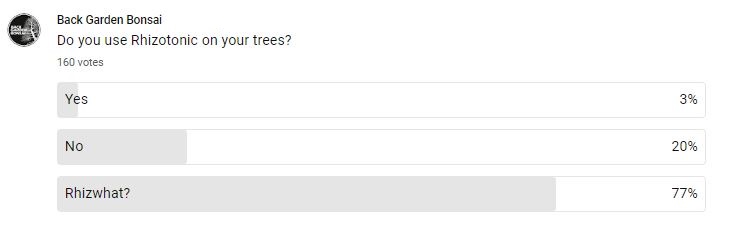
A massive 77% had not even heard of it, which is something I think needs to change. If you are reading this …well at least now you know what the product is now!
Anyway, only 3% said that they use it. I would not take this as “oh, it must be bad then” because the fact professionals use would suggest its actually great. It just seems to be a very well kept secret and people are just not aware of it.
Are Rhizotionic and Superthrive The Same Thing?
This is a huge question, and to be honest, I’m not sure.
It seems like rhizotonic can be difficult to source in America, and if you can it is extremely expensive. However, you do seem to have an American brand called superthrive and the two products are often compared and said to be the same.
I haven’t seen superthrive in person, so I can’t be sure, but from seeing what they advertise, I do believe the products are very similar. They both seem to be a seaweed based product that can add plenty of nutrients to your soil to help your tree grow.
I think they are close enough that you could interchange them, if you can’t get access to one, the other should be fine. Although I have a feeling it is going to be like comparing apples with pears …so close enough, but slightly different at the same time.
This might be a topic that needs further testing.
Could You Use Other Algae Based Products?
There are plenty of other algae based products that are both popular and effective. Whether they can be used in place of rhizotonic, I am not sure, it would really depend on the product.
Some are more aimed at general plant health, sort of like an addition to fertiliser, to help give the tree certain extra nutrients and minerals that are not included with fertiliser.
I am sure there will be some rivals to rhizotonic that offer a similar stimulus to the root, but you would have to check the individual product.
Conclusion
Hopefully now you have a better understanding of what rhizotonic is and how we can use it in bonsai. I really believe it does make a difference and it can help a tree recover from stress a lot faster than just letting nature do its thing.
I would suggest you all get a bottle and see for yourself and see why so many of us thing it is some sort of magical potion.
(You can read more about – What Do Healthy Bonsai Roots Look Like?)

Hi, I’m Ian. I have been doing bonsai since 2014. I created this site to spread all the knowledge I have acquired over the years. Don’t forget to check out my Youtube videos where I show the progress of my own Bonsai each week or connect with me on social media.
You can read more about me and how I got into Bonsai on the About Page
