
Keeping a bonsai inside is a controversial topic.
Trees should really be kept outside. However, depending on the species and your climate, you may need to keep them inside.
If you do keep a tree inside you will need to be able to control the amount of light and temperature throughout the year to suit your trees needs, which can be rather difficult.
However, I there are a few trees I can recommend to keep inside with relative ease.
Page Contents
Portulacaria Afra
The portulacaria afra is easily the best tree for indoor bonsai. It is a fast growing succulent that is pretty tough and responds very well to bonsai work.
As it is a succulent it prefers warmer climates, so it suits living inside a house all year round as it does not need a cold spell over winter.
They do require a lot of light, but I have found they will grow pretty happily on a windowsill. The winter sun may not be strong enough to keep it growing all year but this isn’t really a problem.
If you wanted to put them under grow lights, they will perform much better, but I don’t think that is always required. You can still have great results just from a sunny windowsill, especially if its south facing (or north facing for all my friends on the south of the globe).
The portulacaria afra is also a very tough tree and can be an excellent choice for a beginner. They are able to get some good ramification and leaf reduction, so even a more experienced person can still get a lot from them.
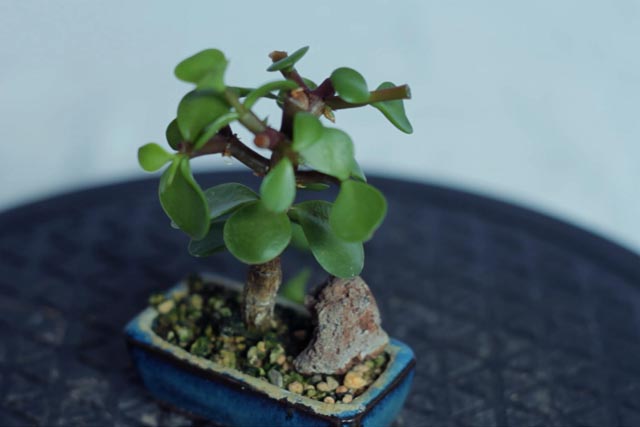
They can be kept quite small which is also going to be helpful if you have a small space to grow your trees in.
If you could only have indoor trees and didn’t want to get involved with grow lights, a portulacaria afra is going to be the best option, they are great trees.
(You can read more about this trees suitability in – Is Portulacaria Afra A Good Tree For Bonsai?)
Jade
The jade plant is the bigger version of the portulacaria afra. (They are not actually related but the portulacaria afra is often refered to as the dwarf jade).
The jade has a lot of the same characteristics as the portulacaria afra. It can live quite happily inside and you will often find it in people’s homes as a house plant.
The jade doesn’t respond as well to bonsai techniques. What I mean by that is the jade’s growth is often larger and it can be harder to get a very small tree from them. However, as a slightly larger tree, you can get some great results.

The jade wouldn’t be my go to tree for indoors, I would always pick the portulacaria afra. However, Jades are a lot easily to get hold of and it’s also easy to find ones with thick old trunks.
Jades are a lot more available than portuclacaria afras so you are more likely to end up with a jade, but if you happen to find a portulacaria, definitely bring it home.
They can both be a lot of fun and are going to survive very well in your house.
(You can read more about this trees suitability in – Is Jade A Good Tree For Bonsai?)
Ficus
The term “Ficus” covers a large number of varieties, but they are all pretty much suitable for bonsai.
Ficus’ usually grows in tropical regions so they do not need to go through a winter. This means you can keep them inside all year round.
Some people like to take them outside during the summer which is fine, but if you do not have this option, it’s not going to be an issue.
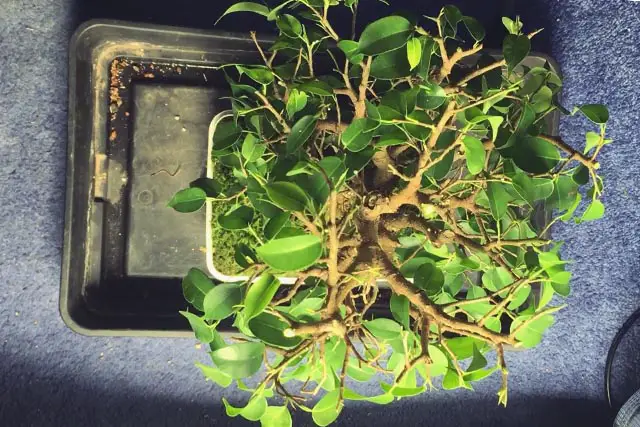
Ficus do like a lot of light all year round, but I have found they will do okay sat in a sunny spot in your house. If you can provide good light all year round they will just keep growing.
If you live in more northern areas you may find your ficus do not grow over the winter. This is fine; it just means it will take a little longer to develop.
Like the portulacaria afra a ficus is an excellent beginner tree but it should also not be over looked by a more advanced bonsai grower. You can get some excellent structure and ramification on a ficus that can result in some phenomenal trees.
(You can read more about this trees suitability in- Is Ficus Benjamina A Good Tree For Bonsai?)
Other Tropical’s
You can find plenty of lists that suggest other types of tropical trees to use as indoor bonsai. As much as these trees are usually okay, they tend to have larger leaves or just generally more coarser growth.
Personally I don’t think there is anything wrong with any of these trees. They are all beautiful and are a lot of fun to grow.
However, being realistic, they are not excellent trees for bonsai. Their leaves are usually too big and you just can’t get that small tight ramification that make high quality bonsai.
This is why I would only suggest you grow portulacaria afra or ficus inside as bonsai, they can really reduce in size and have great ramification.
If you want to grow anything else, certainly do it, but it’s probably just better to classify them as houseplants rather than bonsai. That being said, there are no rules, so grow whatever makes you happy.
Other Trees Shouldn’t Be Inside
You will also see other lists of trees that have all sorts of species on them that are apparently great for indoor bonsai.
Chinese elm is one of those trees that you will constantly be told is indoors.
These types of trees can grow inside, but realistically they will need to go outside at some point.
I can’t class these as indoor trees, because, you can’t keep them inside all the time. If you can’t keep them inside all year round they are useless to people with no access to outside area.
I myself have lots of trees inside, mostly Mediterranean trees, such as olives and pomegranates. I only grow them inside so that I can give them extra light using grow lights. During the winter time I have to take them outside to chill out for winter. (I use the shed so they are still cold, but a little protected).

Nearly all of my indoor trees can survive outside all year. I only want to give them extra light to speed up their development. Once I feel they are developed enough I will move them outside, permanently.
(You can read more about how I care for these trees inside by reading – How To Grow Bonsai With Grow Lights)
Long term I will only keep my ficus and my portulacaria afra inside, as for me and my climate, these are the only trees you should be keeping as indoor bonsai.
Conclusion
If you can, keep trees that are more suited for being outside in your climate so you can avoid growing inside all together.
If you really want an indoor tree, stick with portulacaria afra or a ficus and you should remain pretty problem free with these two species.
If you want to grow any other species you are probably going to need to start looking at temperature and light control which is not an easy thing to deal with.
(You can read more about – How Much Light Does A Bonsai Tree Need?)

Hi, I’m Ian. I have been doing bonsai since 2014. I created this site to spread all the knowledge I have acquired over the years. Don’t forget to check out my Youtube videos where I show the progress of my own Bonsai each week or connect with me on social media.
You can read more about me and how I got into Bonsai on the About Page
