
Removing the tap root from a bonsai tree is something you are going to have to do if you want to end up with a decent root system on your bonsai.
Removing it is pretty simple and I will go through how to do it and why you need to.
Page Contents
What Is A Tap Root?
The tap root is the main central root that grows on all trees, including bonsai.
You will be able to recognise it as it is usually the thick, dominant root and will be growing straight down from the centre of the root ball.

Its purpose is to act as an anchor for the tree. When a tree is growing in the ground it sends down a strong tap root that holds the tree into the ground.
From the tap root, lateral roots grow. These are the roots that grow outwards away from the tree. A lot of these roots will also end up be structural anchors, but they will also have feed rooters coming from them too.
Why We Don’t Need A Tap Root In Bonsai
Bonsai trees live in small pots, so the amount of roots that can live in there is always going to be limited.
This means that we must make sure that this limited space is used to its maximum potential.
Large thick roots are just going to take up too much valuable space. We want the pot to be filled with fine feeder roots so that the tree is able to take up as much water and nutrients as possible.
The tap root does not provide the tree with any nourishment, it is simply for support. This support is not needed by a bonsai. We can wire a tree into a pot and this will keep it safe and secure.
Bonsai pots are also very shallow. Having a long tap root coming out of the bottom of the tree would also mean we could not fit the tree into a shallow pot.
How To Prune A Tap Root On A Bonsai
Pruning a tap root of a bonsai is easy. You just cut it off.
The problem is knowing how much to cut off and when.
A tree will start growing its tap root as soon as it germinates. The first root out of the seed will usually become the tap root. It will just keep getting bigger and stronger until you deal with it.
You can cut a tap root off at any point of a trees life and I would argue that the sooner you do it the better.
I would suggest that you remove it as soon as possible. No matter at what stage of development or age a tree is, the first time you repot it, you should be inspecting the roots and dealing with the tap root if it has not already been removed. If you are growing from seed you can remove it while it is still a seedling.
Whenever you do decide to remove a tap root, it should always happen in spring when you are repotting the tree.
(You can read more about – What Do Healthy Bonsai Roots Look Like?)
How Much Of The Tap Root Do You Cut Off A Bonsai?
This is the tricky part.
You need to remove as much of the tap root as much as possible, while still keeping the tree healthy. This will totally depend on the species and the state of the rest of the roots as well as how healthy your tree is.
You need to find out if the species you are working on can handle heavy root work and you need to evaluate if what you are not cutting off will be enough to sustain the tree afterwards.
Each set of roots will be different and so will the strength and health of each tree. If you are in any doubt about what a tree can handle, always err on the side of caution.
It is much safer to leave a bonsai tree with enough roots to survive and deal with the issue another time, rather than have a dead tree.
If I was repotting a bonsai tree with a tap root I would initially just remove the very tip of the tap root. I would only remove like 1cm, right from the end.
I would access the rest of the roots and see if I can remove anymore. If I can’t, at least removing the tip will at stop the tap root growing any further.
You Only Want One Root Plain
If you look at the roots you will see that staggered along the length of the tap root will be horizontal roots on separate plains.
Ideally you want to just end up with one root plain for your root ball. Sometimes you can pick the root plain you like and remove anything above and below this.
However, this is rare. Usually if you did this, there would not be enough roots left to sustain the tree. You should remove what you can then repot the tree.
When you repot in the future you should be able to remove more of the roots that you could not remove this time.
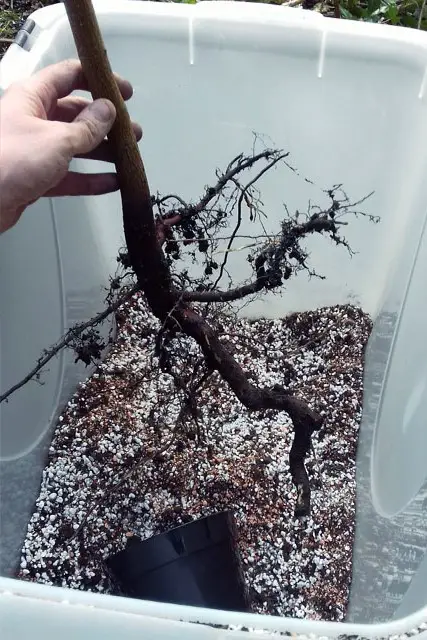
In the picture above you an see the long thick tap root and the other roots coming off this at different points. This tree needed a lot of root work over a couple of years to get it down to one root plain.
What Will Happen After You Remove A Tap Root From A Bonsai?
Once you have removed some, or all of the tap root from a bonsai, it will not grow any more and the other roots will take over.
The horizontal roots, often called lateral roots, will now become the main roots of the tree, which is exactly what you want to happen.
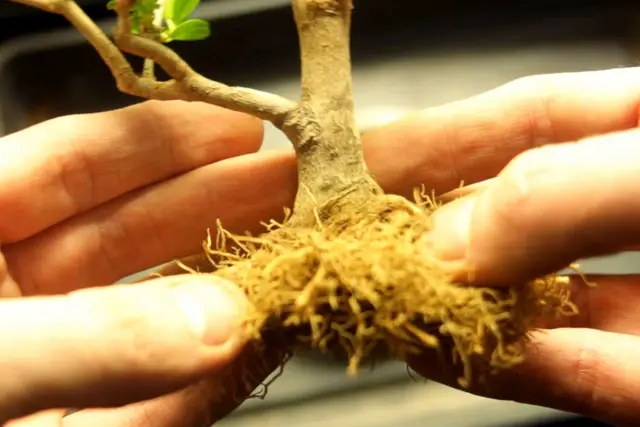
These will spread outwards and thicken. This is exactly what you want, as these will become the future root spread (also called nebari). This is also why you only want one horizontal plain, so your root spread is even and spreading all from the same point on the trunk.
As the tap root will have stopped growing when you cut it off, there is no rush to remove all the other roots that you do not need. You can remove them slowly over the next few years as the roots you do want to keep get stronger.
(You can read more about – How To Develop The Roots)
How The Bonsai Tree Has Been Grown Will Affect Its Tap Root
The age and location of where a bonsai tree has been grown will play a role in how big the tap root is.
A seedling that has been grown in a pot it will have smaller tap root than a tree that has been grown in an open field for many years.
Sometimes when digging a tree out of the ground, the tap root will be so thick and deep that you cannot remove it without killing the tree.
If this happens you are better to leave the tree and try to find another one.
If you really want this specific tree, you could try ground layering it. This will force a new set of roots and will allow you to safely remove the tree. However, this is complicated, takes time and does not work for all trees.
Keep Working On The Roots Of Your Bonsai
Once the tap root is fully removed from your bonsai, whether it is done all at once or in stages over a few years, this only the beginning of the root work.
Once a tap root is removed you will be able to focus on developing the root spread and start building a dense set of feeder roots for your bonsai, that will keep your tree strong and healthy as well as also looking great.
Every time you repot you will get the opportunity to do some work on your roots and develop them further,
(You can read more about – When Should You Repot A Bonsai ?)

Hi, I’m Ian. I have been doing bonsai since 2014. I created this site to spread all the knowledge I have acquired over the years. Don’t forget to check out my Youtube videos where I show the progress of my own Bonsai each week or connect with me on social media.
You can read more about me and how I got into Bonsai on the About Page

