
Air layering is a great way to get more trees for your bonsai collection and it is pretty easy to do, as well as free.
So long as you carry out the technique correctly, which I will show you here, you will end up turning a tree, into many new ones within a couple of months.
Page Contents
Equipment You Will Need to Air Layer
- Sharpe Knife
- Sphagnum moss
- Clear Plastic Bag
- Electrical Tape
- Cling Film /plastic wrap
- Chalk/Marker Pen (optional)
- Rooting Hormone (optional)
Of course you also need a tree to air layer, but I will take it that you already have a tree in mind that you are wishing to remove a section from.
If this tree is not yours/ not on your land, you need to ask who ever owns it if you can air layer a section off. Please just don’t be starting air layers on trees you don’t own.
How To Air Layer For Bonsai
If you haven’t already, you should read my guide on What Is Air Layering? which will explain what happens during this technique.
Understanding how the process of air layering works will help make sure carry out the technique properly.
Pick Where You Want Your New Roots To Be
Deciding where you want the new roots is one of the most important steps. You are basically picking your new bonsai.
You need to pick a branch on the mother tree that has interest. I am often guilty of air layering small, skinny straight branches and these are almost useless for bonsai.
Small branches like this will need a lot of further work, but it does not mean they should be fully written off. If that is the only type of branch you can get, or you just want a duplicate of your tree, then that is fine.
If you can, you should aim for something with interest, movement and character. This way when you remove the air layer from the main tree your new bonsai will be well on its way to looking great right from the start.
Mark Where You Want The New Roots To Be
If you want to, you can mark the bark with chalk or a marker pen. Just draw where you want your new roots to be.
I don’t really do this. I am happy to just look at the branch and decide where I want it. I still take note in my head where I want the roots; I just don’t feel the need to physically mark it out.
If you are new to air layering, you might find it helpful to mark where you want the roots to be, so you can take a step back and analysis it and make sure you are satisfied with your choice as where you mark is going to be the base of your new bonsai once you remove the air layer, so you want it to be good and at the right angle.
Ring Cut The Bark Where You Have Marked
Once you are happy with where you want the roots to be, it’s time to start cutting the bark.
Put your knife in where you want your roots (if you’ve drawn it on, this will make it easier) and cut a ring around the branch. Just make a complete ring all the way around. You need to put the knife in deep enough that it cuts through the bark layer.
Once this ring is done, move your knife down about an inch (if it’s a thicker trunk, you can go a bit lower). You need to go below where you want your roots to be, back in towards the main tree.
Make another cut here. Do the same as the cut above, cut a ring all the way around the branch.
You should now have two ring cuts on your branch.

You can see here in this picture above that I have two cuts, about an inch apart. I used a razor knife, so the cuts are thin; the two red arrows point them out. The future roots will form at the top cut.
(Please note, this is really not an exciting branch to air layer for bonsai, It’s too thin and straight and generally uninteresting, but it demonstrated the procedure visually which will hopefully help you)
Next take the knife and cut a straight line from the top cut down to the bottom cut.

From this vertical cut between the two rings, you should now be able to peel the bark away.
If you are doing your air layer at the right time of year, the sap will already be moving through the tree, so this bark should peel away really easily. It almost pops off in some cases.

You should now have a section of branch without any bark like the picture below.

Scrape The Cambium and Phloem Away /Clean Up The Cuts
The next step is vital, or your air layer will fail. If you look at the picture above, you can see there is like a white fibrous part on the exposed area.
It looks like white fibers running down the left hand side and is a different colour to the more yellow wood to the right.
This white stuff is the cambium and phloem layer. It needs to be removed. If it is left like it is in the picture, the air layer will fail.
This white layer is bridging the two sides of the exposed area. Sugars will still be able to pass through this and head down to the main root system. The plant will see no reason to produce roots where we have cut.
You should make sure this layer is removed by scraping the exposed area with your knife. You should then go over the cuts, just to clean them up and give them a cleaner edge.
The cleaner the cut, the quicker it will heal over and secondly this just makes sure you have definitely cut through the whole layer.
Add Rooting Hormone
If you want to add rooting hormone you can do so now. I have found trees will root without it, but for trees that are slow to root it may be beneficial.
You only need to apply the hormone to the top cut. This is where new roots will form.
Add Plastic Around Trunk
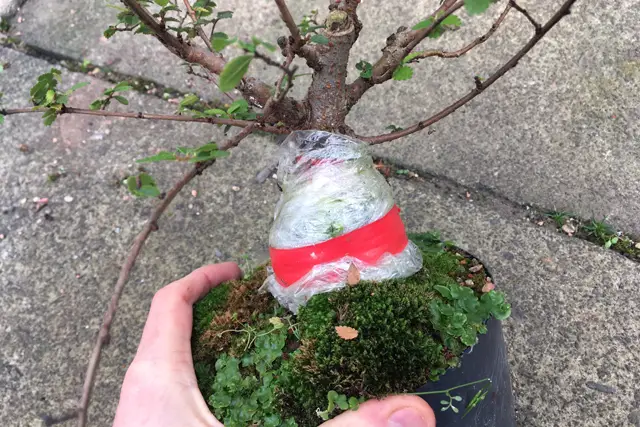
I like to use clear plastic for my air layers. As it’s see-through I can tell when roots have formed. I like to add the plastic just below the lower cut. I wrap it around in a way that it forms like a cone shape.
I use the electrical tape to attach the plastic to the tree. I have seen people use wire for this. Thats totally fine. It is also common to use non-clear plastic, like black bags, plastic flower pots and even tin foil/ aluminium foil.
All of these will work and I’ve actually used them all. However, I prefer the clear plastic as I can see what is happening with the roots.
You will hear the argument that the roots need to be in darkness to grow. This is true. But let me ask you this …How much sunlight does sphagnum moss let through? …Zero.
So the roots are in darkness. When they start to poke through the moss, well yes, they are now in light, but by this time the air layer is ready to be removed and planted so the roots will be in daylight for a short period of time.
Cover The Exposed Branch With Sphagnum Moss
Now you have your plastic cone shape attached to the tree you can begin to pack it full of sphagnum moss.
You want the moss to be damp. it does not need to be soaking. I usually soak it in water before applying it and I ring it out before attaching it.
I have seen people use bonsai soil and even coco fibre. I have used bonsai soil once and it did work, but I would recommend sphagnum moss for best results.
You want to pack the sphagnum moss quite tightly and make sure it is has good contact with the cut points. Try and make the ball as packed as possible.
Tape It All Closed
You can now bring the top of the plastic together to enclose the moss. This will help to make it a ball shape. You can now tape the top so it is secure.
Wrap The Ball In Cling Film
You could probably leave the ball as it is, but I find wrapping it in cling film helps keep it more secure and it also allows the ball to be a bit tighter. This insures that the moss is tight against the cut point.
If it is not fully touching the cut point, it will not root.
Poke Holes In The Plastic
I then poke a few holes in the plastic through to the moss ball. This just allows water to both escape and enter the ball a little easier.
If it’s either too wet or too dry it will not work.
Now You Wait Until You See Roots
You are now done with the air layer technique. Now all you need to do is wait for it to grow roots.
You should check on it occasionally to make sure it hasn’t dried out, but I’ve found I can leave them alone and they are fine.
The waiting is a the hardest part. I have often read it can only take a few weeks to air layer. This is true for some species, but I have found others to be a lot slower.
You just need to wait until you see the roots. It doesn’t matter how long it takes, just wait.
When You See Roots, Remove The Air Layer
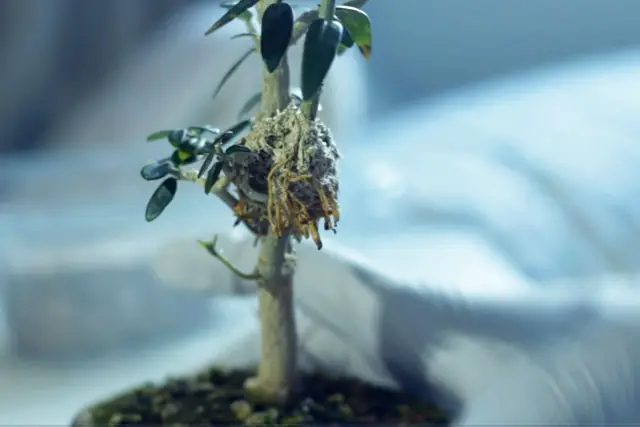
If you are like me and use a clear plastic, you will be able to see the roots form as they will start poking out through the moss.
Do not disturb the root ball until you see the roots.
I would wait until the ball is just totally a mass of roots. It is at this point you will know your tree has enough roots to survive.
When you see this many roots you can remove the airlayer from the tree and plant it up.
If There Are No Roots, Just Keep Waiting
If by the end of the growing season, you see no roots, or very little roots poking through. Just leave your air layer alone.
You can leave it on all winter and it will be fine.
It is actually safer to leave it on the tree all winter, rather than to cut it off and hope it survives with a small amount of roots. When spring comes again you will hopefully see some good roots form and you can then remove the tree.
Air layers really are all about the waiting game. You do nothing until you see there is enough roots. Removing it too early will kill it and you will waste all that time you waited.
Removing The Air layer
Once The tree has enough roots, you can remove the air layer.
I like to saw the branch off just below the moss ball. Once i have it removed, I will then cut off the plastic.
You can then place the whole moss/root ball into your pot and back fill it with soil. I have seen people try to remove the moss at this point, which is very unwise.
Your roots are very delicate at this point and should not be touched. Burying the roots with the moss will not cause it any harm and is the best thing to do. When you next repot you can remove the moss.
Once the air layer is removed from the tree you should treat its aftercare the same as if you just repotted the tree.
(You can read more information about – Repotting Aftercare Advice For Your Bonsai)
Common Mistakes Made When Air Layering For Bonsai
The two biggest mistakes I see people make when air layering for bonsai are:
- Not removing the cambium layer properly.
This means that the sugar supply was never fully cut from the main tree, so no new roots will ever form. You have basically failed before you have even begun.
- Removing the air layer too soon.
I see way to many people removing the air layers after a few weeks, or constantly checking the roots and disturbing them. You need to be patient and wait until your moss ball is jammed packed with roots.
Cutting it off to early is just going to kill your air layer. just be patient and you will be fine.
(You can read more about – What Factors Influence The Success Of Air Layers In Bonsai?)
Conclusion
Hopefully this guide helps you and you manage to get a few successful air layers to make future bonsai with.
You can also see the progress of some of my trees that I have started from air layer:
Yew Bonsai (From Air Layer) Progression
Little Olive Bonsai (From Air Layer) Progression

Hi, I’m Ian. I have been doing bonsai since 2014. I created this site to spread all the knowledge I have acquired over the years. Don’t forget to check out my Youtube videos where I show the progress of my own Bonsai each week or connect with me on social media.
You can read more about me and how I got into Bonsai on the About Page

