
Bonsai trees can live for a very long time. They will often outlive you and will need to be passed on to someone else, which often comes as a surprise to people who did not realise they can live for so long.
Page Contents
How Long Do Bonsai Trees Live?
Predicting exactly how long a bonsai will live for is very difficult as it can be anywhere from 50 years to 1000s of years.
When asking how long a bonsai tree can live for, we must first ask how long a full size tree can live for.
Bonsai trees are just normal trees that are manipulated to stay small. They are genetically identical to full size trees and if planted in the ground, would eventually grow back into a full size tree.
Asking how long any tree can live will really come down to a number of different factors that can affect how long it will survive, which I will look at below.
Factors That Affect How Long Bonsai Trees Live
The factors that affect the age of a full size tree are the exact same factors that affect a bonsai tree.
The Species Affects How Long Bonsai Trees Live
The species of a bonsai tree plays a huge role in how long it will live for. Some species of trees are just genetically deigned to live for longer than others.
As a very general rule, smaller and faster growing species of tree will live for a shorter period of time than the large, slower growing trees.
If you look at fruit trees like apple or pear trees, they are usually quite small and are also quite fast growing. Fruit trees can live up to about 50 years.
A larger, slower growing tree, such as an oak can easy grow to be 300 years old. Then if you take it to the extreme and look at the huge trees, like the giant sequoia, these can be as old as 3000 year olds.
This directly translates to bonsai. The species you use for bonsai will affect how long it can live for.
If we look at the most popular species that are used in bonsai, we will see that a lot of them are quite long living.
Some species of Junipers can live for between 500 – 1000 years.
Many species of Pine can grow for 1000 years.
Many species of Maples can reach 300 years old.
The Amount Of Care Will Affect How Long Bonsai Trees Live
Probably the main factor in keep a bonsai alive for many years is related to the care it receives.
A bonsai tree is 100% reliant on us to care for it properly. The biggest cause of death to bonsai trees is humans.
If we can master the care regime and keep it consistent every single day, the tree will thrive and reach the upper limits of its potential age.
Caring for a bonsai is a lifelong commitment and its care will need to be passed on to someone else when we get too old and pass away.
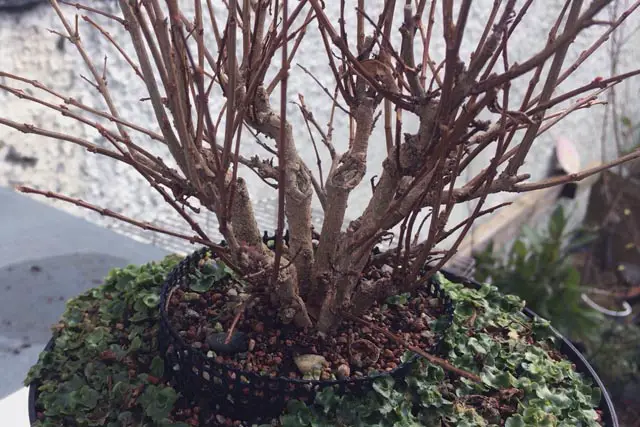
Growing Conditions Will Affect How Long Bonsai Trees Live
We have the ability to control many of the environmental conditions that a bonsai faces, which can all affect how long the bonsai trees can live.
Trees grown in the wild are often killed by adverse weather such as drought, storms and extreme cold.
As we are in full control of the bonsai trees growing conditions we can protect it from these extremes weather conditions and artificially provide it with the environment that is optimum for its growth and health.
We can put bonsai trees in greenhouses when it is cold, we can move them to the shade if it’s too warm, or even use grow lights if we want to give them more light.
Being able to change the environment like this can really help keep a bonsai alive for much longer than a tree in the wild.
Pests/Disease Will Affect How Long Bonsai Trees Live
Pests and Disease are a huge problem for bonsai trees and they can quickly kill them. Trees only have a limited defence against these attacks and can be quickly overwhelmed.
While we sometimes cannot prevent these attacks on our bonsai trees, we can try to reduce the risk of this happening.
We also have the advantage of being able to react to the attacks and try to overcome them with pesticides.
This can give us the advantage of keeping our trees alive for longer.
Nutrition Will Affect How Long Bonsai Trees Live
Trees uptake nutrients from the soil around them. Eventually they will use up all these resources. A tree will keep spreading its roots to try and find more nutrients, but eventually it will reach a point where it is just too over stretched and cannot sustain itself.
This is usually when you see old trees start to decline and die. Depending on where a tree is planted, this can really affect its chances of survival.
However, a bonsai tree does not have this problem. We are constantly watering and feeding our trees so they do not need to over stretch themselves.
The small compact nature of a bonsai actually helps it grow for longer. This means bonsai trees are more likely to be able to last for many many years and reach their genetic age limits compared to trees growing in the wild.
What Are The Oldest Bonsai Trees We Know About?
Some yamadori taken from the wild are estimated or claimed to be 500 year old, which could be true, but we cant 100% prove it.
However, there are a few trees where we can trace the history of them and we get a pretty accurate estimate of their age.
There are a number of bonsai trees that are between 400-800 years old growing in Japan. There is even a ficus bonsai in Italy that is around 1000 years old.
Conclusion
Bonsai trees can live for potentially hundreds of years if not longer if given the right conditions.
With the improvement in record keeping and also technology we will now be able to more accurately trace a trees history and age.
However, we will not be around to see how old they can really get. It is very likely our own trees will out live us and more than likely outlive their brothers and sisters that are out growing in the wild.
(You can also Read – How Long Does It Take For A Bonsai Tree To Grow?)

Hi, I’m Ian. I have been doing bonsai since 2014. I created this site to spread all the knowledge I have acquired over the years. Don’t forget to check out my Youtube videos where I show the progress of my own Bonsai each week or connect with me on social media.
You can read more about me and how I got into Bonsai on the About Page
