
One of the main traits that you want in a bonsai is a good root structure.
This can take a long time to develop, but I will discuss what you want to aim for and how you can get a great nebari this on your own bonsai trees.
Page Contents
What Is A Nebari?
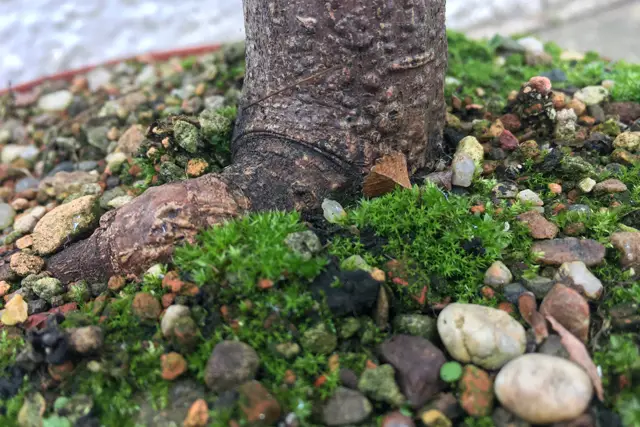
The Japanese call the spreading of the roots from the tree trunk, down to the soil as the “Nebari” and you will often hear it being called this in the bonsai community. I personally prefer to call it the “root spread”, but you can call it either.
The root spread is just where the tree roots transitions form the main trunk out and down towards the ground.
When you start to look at bonsai trees and compare them you will notice how different this transition can be. The angle at which the roots leave the trunk and the amount of roots you can see all change how the tree looks. This section of the tree is like the anchor point to the ground and it can really affect how the overall tree looks.
As bonsai is an art, what is seen as aesthetically pleasing can change from person to person, but it is generally agreed that a trunk and roots looks best when they transition smoothly by flaring out at the base of the tree and then spreading out in a radial pattern form the trunk down to the soil.
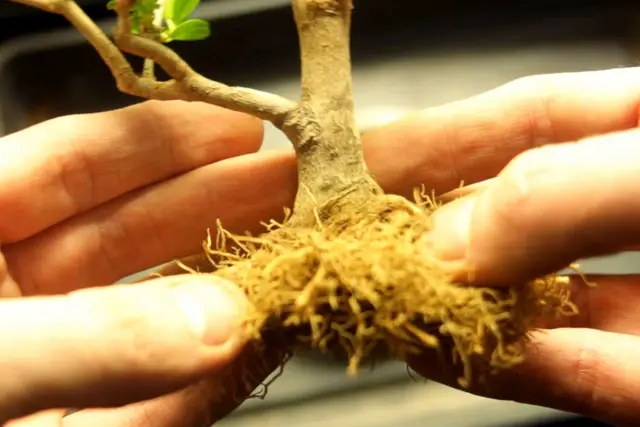
As these roots spread out they should divide and taper down to smaller and smaller roots as they enter into the ground. This gives the illusion that the roots are strong are gripping the soil and anchoring the tree into the ground.
This also makes it seem like the bonsai tree has been growing in this way for many years and is very mature and strong, which is sought after trait in a bonsai.
If you look at a young tree you will see it just goes straight into the ground. It just looks like a stick poking straight out. You can’t see any of the roots and this is not very interesting, it is the total opposite of what we want.
What Is A Good Root Spread (Nebari) On A Bonsai?
The ‘ideal’ root spread on a bonsai would involve the roots slowly flaring outwards and down from the main trunk.
The roots should all leave the trunk from one horizontal level at the base of the tree. This is often referred to as the root plain.
This will make a smoother transition from the trunk down to the soil line. You want this transition to be a gentle slope. This type of transition looks better than a sudden sharp change in angle.
The roots should spread out equally in all directions from the trunk. This will mean that the root system is balanced all the way around the tree.
As the roots spread down from the trunk they will start to divide and have ramification which will make them taper down to a smaller and smaller size as they approach the soil, much like how we like the branches to grow.
The roots should also have some movement. Being totally straight will not look pleasing. We also want this movement to be gentle, sudden changes in angles do not look good. If the roots have a good ramification, this movement will come naturally as the roots divide and will look really nice.
The roots should also not cross into each other. They need their own space as they flow outwards from the trunk. If they are crossing they just look tangled and unsightly.
We also want some of the roots to be exposed. As they move away from the trunk and into the ground we want to see some of the roots on the surface of the soil as it’s slowly transitions outwards from the trunk.
Over time these surface roots will thicken and also get bark, which will further help with the transition between the soil and the trunk.
You can see extreme cases of this type of flaring in many Japanese trees, especially Japanese maples, their roots have flared out from the trunk and overtime thickened and actually fused together forming like a plate of roots spreading out from the tree. Some people say this too extreme and it is often described as a “turtle shell roots”.
The level to which you have your roots flare out and are exposed above the ground is totally up to you and will also depend on the species and the individual tree itself. Some trees will suit a wider root spread than others.
Common Problems Found With Root Spreads (Nebari) On Bonsai
If you know what some of the common problems are you can look out for these on your own tree and try to avoid them.
High Roots Are An Issue
This is when roots grows at different levels along the trunk. All your roots should come out form the trunk at the same horizontal plain.
If you have one root that sits above the rest, it will look strange. Often when you have young trees with the tap root still attached, you will find different plain of roots growing down the length of the tap root. You will have to pick the best plain and remove the rest. (You can read more info on – How To Remove The Tap Root)
Removing high roots is important for two reasons, the first is aesthetical and the second is so that you can physically have your tree in a shallow pot. If you had more than one root plain, you are not going to be able to have both plains submerged in soil in a shallow pot.
Thick Roots Are Not What We Want
You want all of your roots to be roughly the same size. Often a tree will put a lot of energy into one root and it will thicken up and just look very disproportionate to the others.
However, this isn’t always a bad thing. You will often see collected trees that have this problem. The one large root is then used as a feature on the tree and can actually work quite well. You will often see it carved to give it even more interest.
Collected trees usually have this issue as they have been growing wild in the ground and have had no root work done, so usually one root takes all the energy and thickens up a lot more than the rest.
Crossing Roots /Wrong Direction Roots Look Ugly
If you have ever repotted any sort of plant you will know how crazy roots can be. They get super tangled and grow in every direction possible.
In bonsai we do not want this we want the roots to each grow outward and away from each other.
Trees roots will naturally cross over each other or grow out and then change direction to head back in towards the trunk.
These types of roots are usually made worse when growing in a pot, as space is limited so the tree is unable to spread out like it could in the ground and is often forced to grow back on its self or at a weird angle. This just looks very messy and it is something you will need to deal with when you are repotting the tree.
Roots Going Straight Down Are Bad
This is similar to roots going in the wrong direction, but they just go straight down. This is initially seen in a young tree with the tap root. However once the tap root is removed roots will still try and grow straight down.
These types of roots are problematic when you try and plant a tree in a shallow pot. Having a flat root plain, where the roots are shallow but, spread out is better suited for bonsai so you can fit the tree into a shallow pot. You can only get roots like this by removing the downward facing roots.
It is also better to remove these roots so that the energy is distributed to the roots that are more spreading. Over time these spreading roots will thicken and develop into surface roots. If you have down ward growing roots at the base of your tree these will share that energy and it will take you longer to develop the better looking surface roots.
An Area With No Roots Is A Problem
We want roots to emerge from the tree all the way around in full 360° of roots. However, some trees will not do this and certain areas will actually have no roots.
This is again quite common on collected tree. As the tree grows in the ground and allows one root to thicken, the other smaller roots die.
This area of no roots can look quite ugly as the trunk does not taper into the soil. It can just sort of look flat and uninteresting.
Most times this can be hidden by displaying the tree so this section is hidden from the viewer.

If you are finding this article useful you should also check out my YouTube Channel, I post new video’s every Sunday.
I like to show each of my Bonsai trees journey throughout the year in a sort of time lapse, along with some tips and techniques throughout the video.
How To Get A Good Root Spread (Nebari) On A Bonsai
There are a number of different techniques you can use on a tree to develop a good root spread:
Root Pruning Promotes A Better Root Spread
Repeated root pruning over many years is the best way to build your root spread. If roots are left alone they will just grow wild and produce a lot of the issues I have discussed above.
Repotting a tree gives us the chance to address the roots and try to make them better. Repottings main priority is make the tree healthier and to trim its roots back to give it more space in the pot. However, while we are doing this, we can start to address problems and correct things so they grow in a more pleasing manner.
We are able to remove high roots, we can also uncross roots and position them in a better way, or remove them fully. We can remove roots growing in the wrong direction and make sure that if any are getting too strong we can take them back to help balance the energy equally throughout the whole root system. Also removing the downward growing roots will make sure out spreading roots are able to develop and all the energy is going through them.
Balancing the roots like this also helps keep roots growing the whole way around, so we should not get any areas that are lacking roots.

The act of pruning the roots also encourages the roots to divide and ramify. So although we are pruning them to encourage more finer productive growth, we are actually getting aesthetical ramification at the same time.
If this process is repeated over many years you will see the root spread slowly develop. Some trees will develop faster and others it may take decades.
This is all depends on the species as some can handle a lot of work and others you need to be very careful with. You may have to correct these issues very slowly over a number of years. No matter the tree, you must be sure that any work you do will not affect the trees health.
However, with time, you can build a good looking root spread on any tree with root pruning.
Ground Layering/ Air Layering Can Give You Radial Roots
If you feel that the roots are just not suitable, or will take far too long to develop, you can speed the process up by using a layer.
This is where you remove a ring of bark on the tree and force new roots to grow at the cut point. When roots grow, they will usually grow all the way around the whole trunk where you have cut. This is a quick way to develop 360° of roots that are all on the same horizontal plain.
You can do this higher up on the tree and remove the section as a new tree. This new tree will have been set up with a great root system that can be quickly developed over a few years. It will not the usual root problems that are found with trees that are collected or are grown from seed.
(You can read more about – How To Air Layer A Bonsai)
You can actually perform this technique at ground level, or actually even below ground. If you find a tree that you want to dig up, but you know the roots are awful, perhaps there is just one huge tape root and no smaller feeder roots. If you just dug this tree up, it wouldn’t survive or it would take many years to reduce the tap root and build fine rooting.
If you perform a ground layer, you are doing the exact same as an air layer. But instead of removing just a branch, you are going to remove the whole tree and separate it from the tap root.
A ground layer is performed in the same way and will produce the same single root plain with 360° of roots. This should allow you to remove the tree from the ground without the tap root. The roots produced in the ground layer will now be the new root system and should have enough roots to support the tree. These roots should be more suitable for creating a great root spread than what the tree had before.
This technique only works with certain species, so it is not the answer to all our problems, but it is very useful for those trees that it does work on.
Root Grafting Can Give You More Roots
This is not a common technique as it is quite advanced, but it is used sometimes to try and correct areas that have no roots growing.
This technique involves planting a small cutting or seedling in the area where there are no roots growing on the main tree.
A thin layer is cut in the trunk of the main tree and the new smaller tree. These cuts are lined up and pressed together and tied down so they cannot move.
The purpose of this is to allow the two trees to heal and as they do, they will grow into each other and fuse together and become one tree.
The smaller tree will become part of the larger tree. Once the graft has “taken” and has healed, the top portion of the smaller tree will be removed.
All that will be left is the roots, which are now part of the main tree. You should now have roots where there was once none.
Some people try to just wound the area where there are no roots. As the tree heals and calluses over it potentially will grow roots in the area that was damaged. This method is not guaranteed to work, but is often tried before grafting is attempted.

Conclusion
Developing a root spread on a bonsai takes time and careful consideration.
Balancing the bonsai trees health and deciding how much work to do can be difficult, but with time and effort you can end up with a really powerful root spread that will make you bonsai look aged and powerful.
Just keep slowly working your roots over time and you will start to see them develop.

Hi, I’m Ian. I have been doing bonsai since 2014. I created this site to spread all the knowledge I have acquired over the years. Don’t forget to check out my Youtube videos where I show the progress of my own Bonsai each week or connect with me on social media.
You can read more about me and how I got into Bonsai on the About Page

