
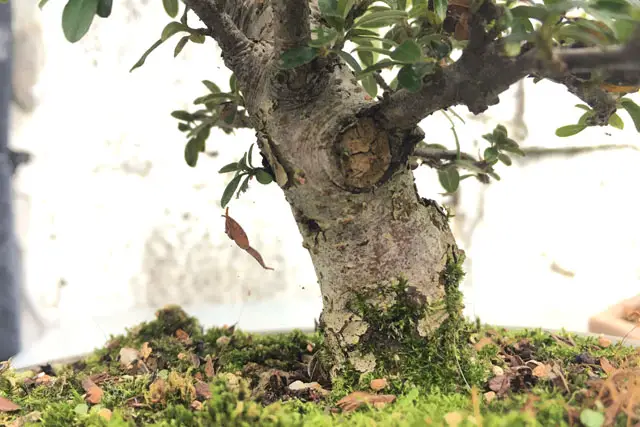
Cotoneaster is a small semi-evergreen shrub that is often found in gardens. It has naturally small leaves and gets covered in little flowers that turn into red berries.
There are a number of different species, all with slightly different leaf shape, size and growth habit, but in general they make excellent bonsai and can be cared for in a very similar way.
You can follow the development of mine in my Cotoneaster Bonsai Progression.

Page Contents
What Is The Natural Habitat of A Cotoneaster?
Cotoneasters are native across Europe and Asia.
They are very popular as garden plants and have actually managed to escape and are now seen as an invasive species. In some areas as they are taking over and stopping native plants growing there. This has happened through birds, who have eaten the berries and then spread them outside of gardens and into the wild.
What Soil Do Cotoneaster Bonsai Need?
Cotoneaster bonsai prefer a moist, well draining soil, but they grow in a lot of different gardens and are now seen as invasive would suggest they grow in less than ideal conditions.
I use my standard mix of equal parts Perlite/Molar Clay/Compost and have no problems. A free draining soil like this is going to get you the best growth and root development.
(For more info on soil read – A General Guide To Bonsai Soil)
How Do you Water A Cotoneaster Bonsai?
Cotoneaster bonsai will take plenty of water when they are actively growing. If you are using good soil your pot will remain moist and not become waterlogged. You can water it just as is beginning to dry out.
(For more info you can read –How To Water A Bonsai)
How Much Sun Light Does A Cotoneaster Bonsai Need?
Cotoneaster bonsai can take full sun. They will grow in shade, but you will get better results in the full sun.
How Hardy Are Cotoneaster Bonsai?
Cotoneasters are very hardy, they survive across northern Europe with no problem and can handle temperatures as low as -15°C / 5°F when grown in the ground.
In a bonsai pot, it may not be able to cope as low as this, but it can withstand anything in the UK and I leave mine outside all year long.
If you are in an area that is getting that cold, I would put the tree somewhere protected, such as an unheated greenhouse or shed before the temperatures reaches this low.
(For more info you can read – Working Out How To Over Winter Bonsai Trees)
How Often Do You Feed A Cotoneaster Bonsai?
I feed my Cotoneaster bonsai once a month during the growing season with a general all purpose fertiliser which is enough to keep them healthy.
(For more info you can read – Do You Need To Use “Bonsai” Fertiliser?)
Repotting A Cotoneaster Bonsai
Cotoneaster bonsai should be repotted in early spring as the buds are swelling and about to open.
They can be given a hard root pruning, so long as the tree is healthy you should not have any problems. Cotoneasters are very strong root growers and should bounce back very quickly.

(For more info you can read – How To Repot A Bonsai Tree)
How Do Cotoneaster Bonsai Respond to Pruning?
Cotoneaster bonsai respond very well to hard pruning and can also be pruned to shape. They will back bud quite easily and it is easily to build your main structure using pruning.
(For more info you can read- How To Prune A Bonsai Tree)
Wiring A Cotoneaster Bonsai
Cotoneaster bonsai can be wired. They get very dense foliage at times, which can make wiring the small branches difficult. These parts of the tree are better formed with clip and grow, but you can certainly wire the main structure into place.
(For more info read – Why Do We Wire Bonsai?)
What Is The Leaf Pattern Of A Cotoneaster Bonsai?
Cotoneasters have an alternative leaf pattern.
A lot of varities are evergreen, but you may find you have one that is semi-evergreen and it may lose a lot of its leaves over winter, but maybe not all of them.
What Pests Does A Cotoneaster Bonsai Suffer From?
Cotoneaster bonsais can suffer from the bacterial disease fireblight. This will make the leaves look like they have been burnt in a fire. If this happens you need to remove the any infected area and cut it back to unaffected wood, then burn anything your removed to kill the bacteria and stop it form spreading.
This inst very common, but it is something you should be aware of and you should check your tree often to make sure they are healthy.
Can You Propagate A Cotoneaster Bonsai?
Cotoneaster bonsai will root easily from cuttings and air layers can be taken. You can also grow them from seeds easily, but they will take a long time to get any sort of thickness, so it is easier to use air layers when growing them as bonsai.

What Is The Growth Rate Of A Cotoneaster Bonsai?
Cotoneaster bonsai grow at a medium speed.
They can put quite a lot of growth on very quickly, but it can take a while for the branches to thicken. If you can start with a piece of material that has a good trunk, you can very quickly build out your foliage and end up with an excellent bonsai.
Of course the warmer and sunnier your environment is, the faster your growth will be.
Should You Get A Cotoneaster Bonsai?
Cotoneasters are great bonsai trees. They are naturally very good for bonsai as they have small leaves and ramify well and they just generally look cool.
They are also very robust and can handle a lot of neglect and beginner mistakes, which makes them easy to grow and care for as bonsai.
The added bonus of small flowers and berries makes them a great choice for anyone, including beginners. You can read more about If Cotoneasters Make Good Bonsai Trees

Hi, I’m Ian. I have been doing bonsai since 2014. I created this site to spread all the knowledge I have acquired over the years. Don’t forget to check out my Youtube videos where I show the progress of my own Bonsai each week or connect with me on social media.
You can read more about me and how I got into Bonsai on the About Page

