
In bonsai, there is a lot of terminology that can confuse a beginner. I am making a short list of some of the common words and phrases that often appear, sort of like a little bonsai dictionary to help you get a clearer understanding of what we are all talking about.
A lot of the time you will hear Japanese words being used. There usually is an English equivalent, but people just like to use the Japanese terms. There is neither right or wrong, but it is something you should be aware of.
Page Contents
Common Bonsai Terminology:
The following words are commonly used in Bonsai. I’ve put them In alphabetical order. If there is something you think I’ve missed out, let me know an I will add it, so you can know what it means.
Akadama
Akadama is a unique clay that is mined in Japan. It is a component used in some bonsai soil mixes. Its properties work every well for growing plants in and is often said to be the best soil component you can use.
(You can read more about – Why Is Akadama So Expensive?)
Apex
This is the name given to top section of the tree. The top section will usually grow faster than the other areas of the tree so it will often be talked in bonsai as separate work may need done to this area.
Back Budding
This is the process of trying to produce buds closer into the tree. Usually a branch will grow outward and keep growing form the tip. It will just keep growing outwards, which is not idea for bonsai as you can’t just have 3 meter long branches.
There are various techniques to produce back budding, but the principle is to promote the growth of the inner (often dormant) buds. When these grow you can then cut the rest of the longer branches back to these newer ( and closer to the trunk) buds. This then makes the overall size of the tree a lot smaller.
Bud
A bud is small little bump on the tree that will slowly swell and grow into a new leaf. This will then form into a branch. The buds can be anywhere on the tree, but they are usually found in areas such along branches, at the bases of leaves.
Callus
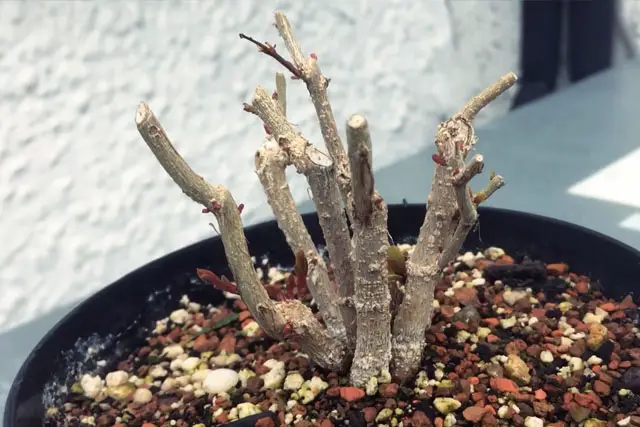
This is what we call the process of a tree healing itself. Similar to the way we form a scab when we are cut, a tree will form a callus. The callus grows at the edge of the wound and as the tree expands over time, it rolls into the centre of the wound and covers it. Over time the two sides will meet in the middle and the wound will be fully sealed over.
Deadwood
This is the general term given to areas of the tree that are dead. These areas are kept on the tree for aesthetic reasons to show the contrast and struggle between the living and dead parts of the tree.
(You can read more about –How To Create Deadwood)
Die Back
This is when a small section of a tree dies. This will mainly happen in areas where you prune. The point at which you make the cut will “die back” to the node that is directly below it.
If you cut a branch in-between two leaves. The section between the cut and the leaf below will die. The tree sees no benefit in keeping this small section so it allows it to die.
Internode
This is the section of branch in between two leaves. The node is the area of the branch where the buds and leaves will form.
The internode is important in bonsai as the smaller this section is, the shorter and tighter the branch and foliage will be. This will make the tree look small and compacted
Jin
This is the Japanese word for a dead branch that has had its bark removed. Jins are one type of deadwood you can find on a tree
Literati
This is a style of tree. It is hard to translate exactly what it means and the definition is often argued over. Usually these types of tree are quite tall bonsai with long thin trunks and only a small section of foliage at the top.
Mame
This is the name for a Japanese size classification of a tree. In Japanese exhibitions they have different categories of trees, which are classified by a trees height.
In the western world we seem to be very loose with these terms. To start with, finding a definitive answer on what the actual height is. I’ve seen ranges from 6-15cm. which is pretty broad.
Basically a mame is a very small tree that you can probably hold in your hand.
You will often hear it as “the smallest” type of bonsai, which is actually wrong as there is a classification size lower than mame.
However, realistically it doesn’t really matter. I’m going to strongly assume you will not be entering your tree into a Japanese exhibition, so the height of your tree, and how it would be classed, is pretty irrelevant.
If you want to call your small tree a “mame” Then that’s cool, you can get the tape measure out, but I’d say that’s not really necessary.

Nebari
This is the Japanese term used to describe the root spread. I have written about this in more detail Here
Shari
This is another Japanese word that describes another type of deadwood that can be found on a tree.
This type of dead wood is found on the trunk. It is often found in the form of a dead vein, which contrasts with the live veins twisting around it.
Shohin
This is the name of another height classification at Japanese exhibitions.
These trees are pretty small. However, again trying to find a confirmed height is difficult, I’ve read anywhere between 15-20cm tall.
Much like mame, it doesn’t matter what height your tree is. You will actually find that when you buy pots, they sort of roughly fall into size categories. I have a number of pots that I feel are the right size for a “shohin” size tree. If the tree happened to be 21cm …yes, it would now no longer technically be a shohin, but I’d still call it that, as my trees are not part of a Japanese exhibition.
So again, if you want to use these terms to roughly describe your trees, that’s fine, just be aware that it is not accurate until you get your ruler out, which I feel is a little over the top.
Tanuki
Tanuki is the Japanese term used for something we call a “Phoenix Graft” They are a pretty controversial topic in bonsai. Personally I’m not interested in them, but they can look good.
They are made by taking a piece of deadwood and a small young tree. The tree is laid into the dead wood, so that it looks like they are one tree. Often grooves will be carved into the deadwood so the tree can be pushed into the grove to make them look even more as one piece.
The goal is to create a bonsai that looks like it has a lot of deadwood. Normally a tree would have to be grown for many years to achieve this amount of growth and deadwood. By merging a young tree and deadwood, it is more of an instant illusion.
This is controversial as some people see it as cheating, or lies and not pure. They would rather have a tree that was very old and naturally this way.
Whatever your opinion it is good to know about these. Sometimes you will get conmen trying to rip people off by selling freshly made tanuki by saying they are really old bonsai. As a tanuki is really just a young tree, it should not be worth the same amount as a very old tree.
(You can read more information about What Is A Tanuki Bonsai?)
Yamadori
This is the Japanese term for digging up wild trees form the mountains and bringing them down to turn them into bonsai.
This term is generally used whenever someone digs up any tree from the ground to be used as bonsai.
You may also hear the term Urbandori, meaning the tree has been dug up from an urban area, such as removing an old hedge to make into bonsai.
Conclusion
You will see these words pop up all of the time when you are learning about bonsai, so hopefully now they will make more sense and you can understand what every one is talking about.
It will not take you long to start using a lot of these terms yourself and they will become second nature.
You can read more about – What Are The Benefits Of Having A Bonsai Tree (And Are There Any Negatives?)

Hi, I’m Ian. I have been doing bonsai since 2014. I created this site to spread all the knowledge I have acquired over the years. Don’t forget to check out my Youtube videos where I show the progress of my own Bonsai each week or connect with me on social media.
You can read more about me and how I got into Bonsai on the About Page
