
Starting and expanding your bonsai collection can be done in a number of different ways.
A bonsai tree is never “finished” it is always on a slow journey to becoming better and better throughout its life, there is no end goal. You can add a tree to your collection at many different stages of this journey, from very young all the way up to extremely developed.
What type of trees and at what stage they are in development when you add them to your collection all will depend on the amount of time, effort and money you are willing to put towards them, as well as what you prefer and enjoy.
However, no matter your situation, you can always start your collection and begin to expand it right now. In this article i will go through the 6 main ways to get new trees into collection.
Page Contents
1. Buying A Tree
The quickest and easiest way to start a bonsai collection is to buy trees. This can be done online or at a Bonsai nurseries. There are a number of different options as to what you can buy, which will affect the cost and the level of development you get.
Developed Trees
Although bonsai trees are never ‘finished’ then can be quite developed and look amazing. Developed trees are the ones you look at and say “That’s a bonsai”. Most of the work has already been done on these trees. They have a good structure and style and now just need looked after and maintained.
This option will be the most expensive. The tree usually costs more the older and more developed it is. Basically you are paying for the time that has been put into growing and caring for the tree.
(You can read more about – Why Are Bonsai Trees So Expensive
You can still buy trees that have some simple and basic development that are a lot cheaper. This would be like the £15 Chinese Elms you can easily find on Amazon. These trees are a lot younger and have had a lot less work done on them especially when compared to the trees selling for thousands of pounds.

Pre Bonsai
A slightly cheaper option would be to buy a pre-bonsai. This is a tree that has begun its life as a bonsai. But it still requires a lot of work. It may have aspects of its character developed. But it’s not quite fully developed. You may find that the trunk has been grown thick but it hasn’t been styled or it may not have had its foliage developed into fine ramification. Maybe it’s had its roots have developed, but the upper structure hasn’t been worked on yet.
A tree in this state is not quite the same as buying a tree from a normal nursery, as it has had at least something done to it to start it on its bonsai journey.
This option lets you bypass a lot of the slow unexciting elements, such as developing a trunk and allows you to get straight to work. Trees like this can be like a blank canvass. No major decisions have been made. It is all up to you to pick a direction for the tree and start to style it and shape it as you see fit.
Trees like this take some work, but you can get a real sense of achievement from them and can quickly turn something messy into something worth looking at.
Yamadori
Yamadori refers to trees that have been taken from the wild and I will talk about that below in more detail. However, they are very sought after and they are also quite difficult to get. They are both difficult to find in the wild and difficult to remove from the ground. This means there is a very healthy market for these types of trees and they can get quite expensive.
Yamadori trees will have very impressive trunks and an overall character that has been shaped by nature over many years. Trying to recreate this yourself is almost impossible. You can save yourself a lot of time by paying for a tree that already has these characteristics.
Nursery Stock
The next option would be to go to a local garden nursery. Yes, the type you would go to get plants and flowers for your garden. On the surface this doesn’t seem like a good place to get bonsai material, but these nurseries sell trees, shrubs, garden hedges and bushes. Although these are sold for planting in the landscape, they can also be very suitable for bonsai.
Depending on the species, and what work needs done to them, this process can be really quick, certainly within a few years you can have a great bonsai tree from basic nursery stock.

The plants here are usually a lot cheaper than buying yamaidori or pre bonsai. This is normally because the trunks may not be as powerful and of course, no bonsai work has been done to them. However, some of the material can still make excellent trees with enough time and effort.
(You can read more about – How To Pick A Tree For Bonsai, From Nursery Stock)
2. Yamadori
You can also go and collect yamadori yourself, If you don’t want to buy it.
Yamadori very loosely translates from Japanese as taking trees from the mountains. Many years ago people would go up in to the mountains and dig up really old fantastic trees. They would then bring them back down to the city and put them in bonsai pots to be enjoyed.
The rough mountain climate caused these trees to struggle for many years. They would be small, or would have been damaged and contorted by the weather. All this hardship resulted in trees that are the perfect size and shape for bonsai with fantastic character.
Although Japan has made it illegal to now collect trees from the mountains, other countries still allow it and you can also collect trees from other areas than the mountains. Bogs and farmland are also excellent places to find trees growing wild.
The main thing to remember is that all land is owned by someone, even if it’s the government. You must always make sure you have permission to take a tree. Some countries will give you a permit and have certain rules you must follow, others will simply just tell you its fine. Either way, you need to check and you need to ask. Trees can also be collected from private land. This is usually easier as asking the landowner is fairly straight forward and they usually don’t mind.
Once you have permission you can go and find a tree that is small with great characteristics. Hopefully it has been growing somewhere where it has struggled to develop long thick roots. This will make its removal easier as well as making its transition to a pot a lot simpler.
Once you have the tree dug out and brought back home it will need extra care and attention to reacclimatise from being taking from the land. However once it is established and can be worked on, you will very quickly end up with an excellent tree. Some yamadori can only take a few years to really transform into something stunning.
Yamadori can be one of the best ways to add very high quality material into your collection for free.
3. Air Layers
Air layering is a very simple propagation process that can quickly increase your tree collection.
Air layering only works on some species, but if you have the correct species, it can be done on your own bonsai trees, so you can multiply what you already have.
It can also be done on the full size trees you have in your garden, if you think any of them may be suited to bonsai. Having a miniature version of what is in your landscape is always special.
You can also ask people if you can air layer their trees. Some may find this strange, but once you explain, I’m sure they will be fine with it.
Air layering is a great way to quickly get more trees, that hopefully have some good features like a good trunk structure and shape. the process can take a few weeks to a few months before you can removing the air layer and have a new tree.
(You can read a full guide on – What is Air Layering For Bonsai)
4. Cuttings
Taking cuttings is a great way to quickly increase your collection.
Cuttings in general are a really popular way to propagate more plants in all areas of horticulture. The Process is really easy; you just cut off the tips of a branch, maybe a few inches long and plant this up. Eventually this will root and become a new tree. The caveat with this technique is that it doesn’t work for all species of trees. Some species are also more effective than others.
There are also some basic rules about when and how to take the cuttings, which can also be species dependant, but apart from that, its a very easy technique that can be very useful.
Taking cuttings for bonsai can quickly grow your collection of trees. You can take cuttings from trees you already own, or get some different species from someone else (I would ask first, just don’t go around taking cuttings). The beauty with cuttings is the fact you can take them from any size tree, so even if a neighbour has a full grown tree you think might be good as bonsai, you can ask them if you can have some.
The main issue with cuttings is that you can only take small ones, basically little twigs. This means it is going to take a while to get them to be a good bonsai, but so long as you are willing to wait and put some work in, they are a great option.
5. Seeds
Seeds can be both the cheapest and longest method of getting more bonsai into your collection. However, some say it is the most satisfying and rewarding way to do things.
Seeds can be cheaply bought, or even collected for free from the local area or even from foods you might already have in the house, like apples.

It can take a lot of time and work to grow anything from a seed. A seedling is not a bonsai, so you will have to do 100% of the work to get it there. This will take many years, but as it’s grows you can have full control of how it is grown and cared for.
(You can read more about – How To Grow A Bonsai From Seed)
6. Gifted Trees
Being gifted something isn’t really in your control, so it is not the best way to grow your collection, but it can happen.
You should also never expect a gift from anyone or try and tell them what to get you, but if you share your bonsai passion with your friends and family they may get you something bonsai related for a special occasion.
Letting them know how much you love trees and showing them how much care for them and effort you put in to your trees might stop them from buying you that set of socks this Christmas and instead get you something more interesting.
If you have other bonsai friends, you can gift them trees. They will probably give you some back in return. I guess this could also be classes as a swap, but sometimes its nice to just give trees and expect nothing in return. This is a great way to increase the species and types of trees you have.
How Do Most People Get New Bonsai?
I thought it would be interesting to ask my Youtube subscribers how they like to start new bonsai and here are the results:
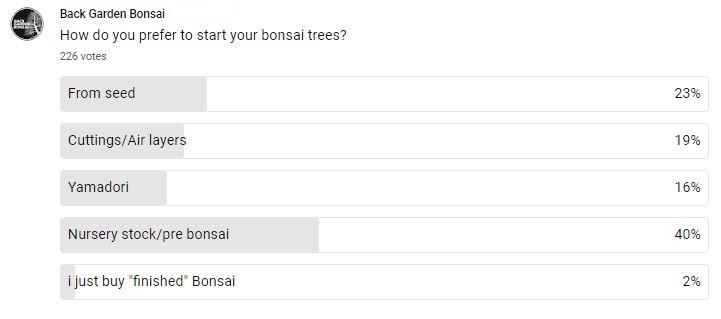
As you can see, the clear winner is nursery stock with 40%. I can fully understand this, it is the best all round option. You do get some head start with the trees development, but you are also free to make a lot of the decisions to progress the tree.
It is also interesting that buying “finished” bonsai trees only got 2% of the vote, it goes to show a lot of bonsai is about the journey, not just buying the end product.
Conclusion
Now you can see that getting new bonsai trees and expanding your collection is something you can do relatively easy and quickly.
There is nothing to say how large or small your collection should be. There are also no rules on the number or type of species you can own. Just have as many as you are happy with, or as maybe you are like me and will only stop getting trees when you run out of space for new ones.
Either way there is no rush and just go at your own pace and maybe try experimenting with the ways to get new trees to see what ones you like best and what suits you needs.

Hi, I’m Ian. I have been doing bonsai since 2014. I created this site to spread all the knowledge I have acquired over the years. Don’t forget to check out my Youtube videos where I show the progress of my own Bonsai each week or connect with me on social media.
You can read more about me and how I got into Bonsai on the About Page

